
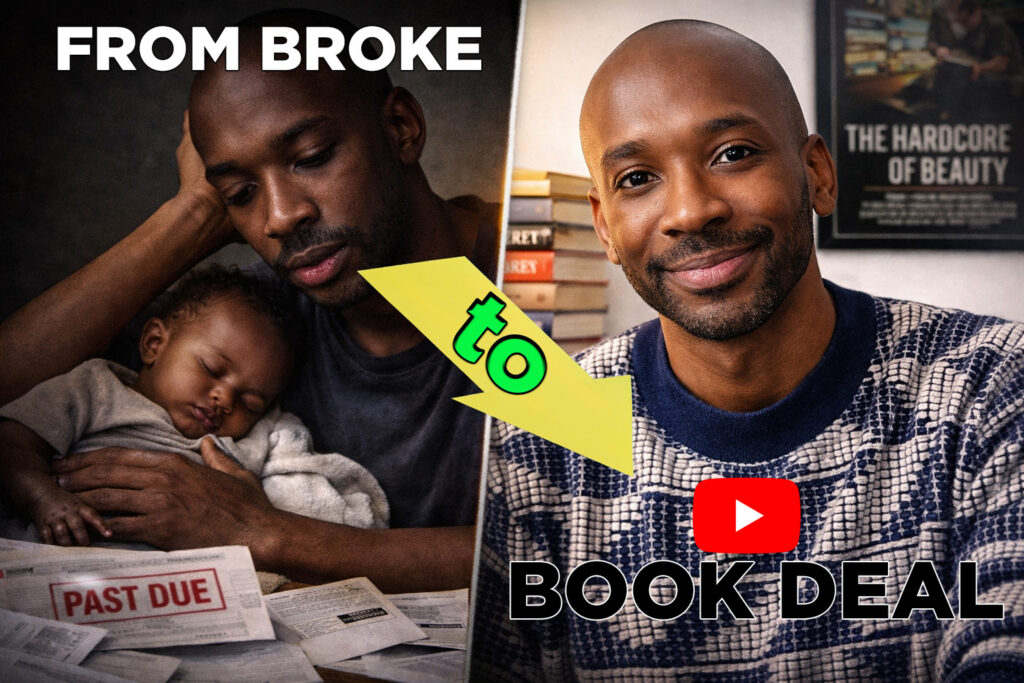
You’re supposed to starve. You’re supposed to treat poverty like a personality trait. And if you don’t, well, maybe you’re not a real artist.
Would you ever give that advice to somebody? Then why do we give it to ourselves?
Kern Carter spent some time in that trap, but found out for himself that it didn’t have to be that way. Lets dive into how he flipped the script and wrote his own future.
Making Money As A Writer
He told me he knew he wanted to be a writer at eight years old. Eight. Most of us were still trying to figure out how to ride a bike without crashing into a mailbox. Kern already had a direction. But life didn’t exactly roll out a red carpet for him.
He said, “I had a child when I was 18. I ended up dropping out of high school. Me and my daughter’s mother lived on our own.”
That’s not a poetic backstory. That’s survival. But Kern kept going. He said artists have this idea that being broke is some kind of rite of passage. Like you have to suffer to earn your place. Like you need to be homeless or writing novels in your car to prove you’re serious.
I’ve felt that. I think most creatives have. Kern had to unlearn that. He had to pull that belief out of his head like a splinter.
And then he got hit with a reality check from a professor who told him it would take five years to learn to write, five years to build readers, and five years before he’d make any money. Fifteen years. Not fifteen minutes or fifteen viral posts.
Fifteen years.
Most people would hear that and quit. Kern heard it and thought, “Okay. So this is the timeline.” It gave him permission to slow down. To stop expecting magic. To treat writing like a craft instead of a lottery ticket.
But the real turning point wasn’t the timeline. It was the moment he realized he could make money as a writer even if he wasn’t making money as an author.
He said, “Once I figured out how to make money as a writer, not as an author…”
That’s when everything shifted.
Copywriting Ghostwriting Websites Campaigns
He used the same skill he’d been sharpening since he was eight, but he used it in a way that paid the bills. And once the bills were paid, something interesting happened.
The writing got better.
He said it wasn’t an accident that he got published after he became financially secure. Because creativity doesn’t thrive in panic. It doesn’t bloom when you’re counting dollars and hoping your car doesn’t break down this month. It needs space to breath.
And once he had that space, the books came. He made a movie, and readers started discovering him. He sold fifteen thousand books in a year without a massive social following. Not because he suffered harder, but because he stopped believing he had to.
Take away:
“Commit. So every decision after that is easy.”
Commitment isn’t glamorous. It’s waking up early and saying no to the wrong opportunities. and choosing the long game when everyone else wants shortcuts.
That’s also the moment the starving artist myth loses its grip. Talking with Kern reminded me that the dream doesn’t change. The identity does.
If you’d like to catch the whole interview, check out my podcast. https://brentxp.podbean.com/e/lightminded-arts-33-writers-dont-make-money-he-made-hundreds-of-thousands-proving-them-wrong-kern-carter/?token=c729849361d493251c3d5f38094b8c09
If you’d like to learn more about Kern Carter, visit him at: https://www.kerncarter.com/
Leave a Reply