
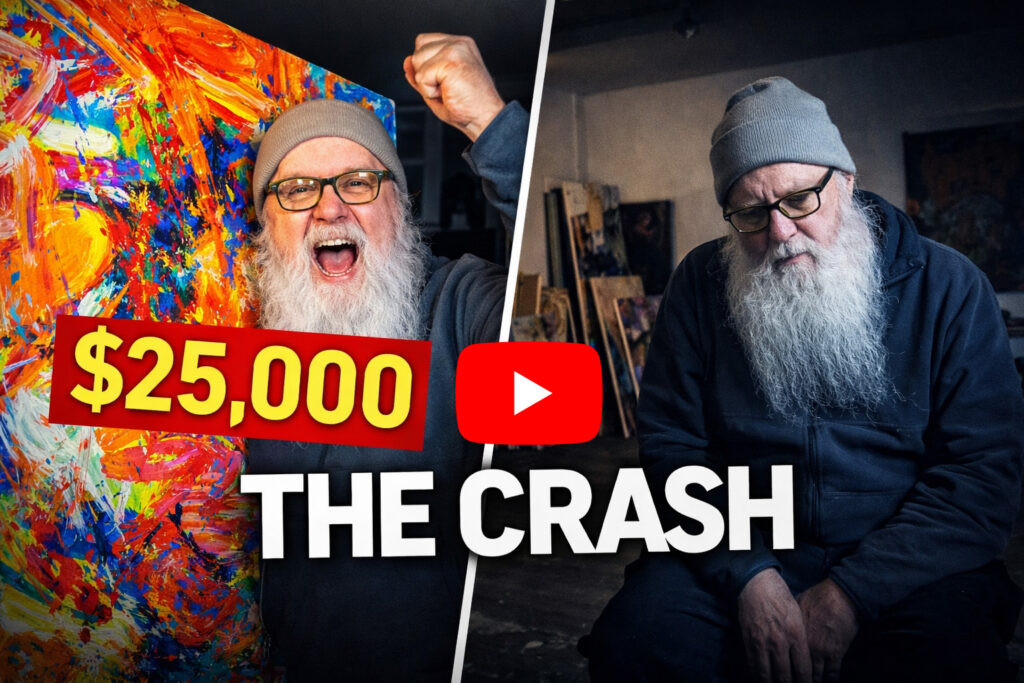
Julian’s life reads like a map of restless searching: born in London, raised under the Spanish sun, chasing meaning across continents until he landed in America.
Julian talked about the financial panic, the spiritual exhaustion, and the constant tug-of-war between survival and creation.
He told me about selling two massive paintings for twenty-five thousand dollars, a moment that should’ve changed everything. And then… nothing. Months of silence.
How is that, when you get a taste of success, and you think, finally, I’m seen. But the art world moves on.
Julian realized something that every artist eventually has to face: The system won’t save you. You either build your own ladder or you stay waiting at the bottom.
He tried everything from running his own galleries, selling online, and moving across states and even back to Spain. Each time, the same pattern: a spark, a crash, a rebuild. And through it all, he kept painting. Not because it was profitable, but because it was what inspires him.
He realized something that matched the entire reason I got into writing and filmmaking also. If we don’t find time to pursue our artistic dreams, then the world will go on without us, and in the end we will have become nothing but dreamers. I prefer to be a doer.
It’s not about art either, it’s about your identity. It’s about refusing to die with your work still inside you.
Julian’s story isn’t a tragedy. In fact, he still sells his art. He’s not a rich artist, but he finds ways to support himself during the slow times. That’s a good lesson for many of us. Don’t discount a day job. We need to provide for ourselves, and the art isn’t always going to make us rich. Some of us will win the lottery and hit the big time, but until that happens, if it ever happens, keep your feet firmly planted on Earth and pursue both with a little bit of brains.
Biggest Lesson
There was one thing that I took away from our conversation that made a lot of sense too, and it was when he was talking about selling his art on the street. He would try to produce these works of art that spoke to him. Passers by would snub his art and go to the guy next to him and buy the cheap mass produced tourist art.
Another thing he mentioned was that when he built his studio in Spain, he did it in a wealthy area, and the people who had lots of money were more able to spend big on his paintings.
These examples lead to a couple poignant conclusions:
1. You need to get lots of eyeballs on your work.
2. You need to be priced right for the market you’re in.
3. You need to know what the audience that is seeing your art is going to value.
If you can align your artistic business plan with these tips, you’ll have a much better chance for success.
Leave a Reply