
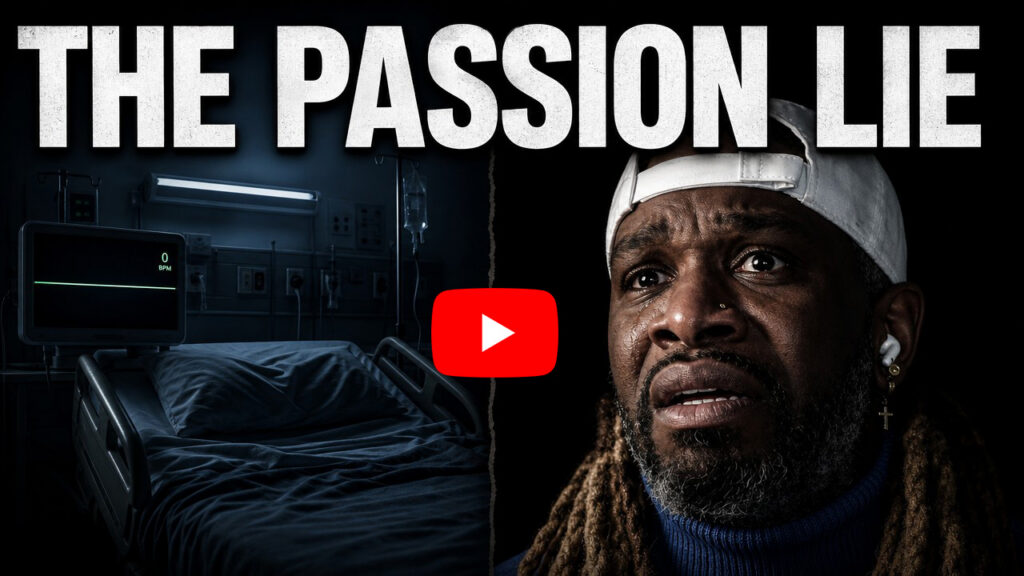
How many of you have heard this bit of advice:
“Just follow your passion and the money will follow.”
It is printed on posters, preached by well-meaning mentors, and echoed across every corner of the internet. It is comforting, it feels deeply inspiring—and it is an absolute trap.
Believing this myth is exactly how highly talented, deeply passionate artists spend decades trapped in survival mode, completely broke, only to reach the end of their lives looking back with nothing but regret.
As I interviewed David Prosper aka The Clarity Guy, he exposed the toxic underbelly of popular self-help culture and laid down his structural blueprint for how creatives can actually survive and thrive.
1. The Four Chilling Words of Deathbed Regret
David Prosper’s obsession with helping people move from stagnation to absolute certainty didn’t come from a textbook. It came from a hospital room in 2016, where he watched his mother transition from life to death.
“I’ve walked with people on the end of their journey,” David shares. “Most people that I’ve walked with who transitioned—my mother included—never talked about the things they did. They talked about the things they wished they could have done.”
On her deathbed, David’s mother cried out four devastating words: “I wish I did enough.”
That moment became a catalyst. David realized that millions of creatives lock themselves inside the “prison of public perception,” compromising their intrinsic gifts just to satisfy the opinions of people sitting safely on the sidelines. They chase superficial checkboxes of “success” while entirely starving their sense of fulfillment.
2. The Illusion of Talent: Why Creatives Get Stuck
If escaping the trap isn’t just a matter of working hard or being talented, what is it? We all know blindingly gifted writers, musicians, and filmmakers who are entirely paralyzed.
David breaks this down into three strict elements: State, Story, and Systems.
| The Element | The Creative Reality | The Psychological Framework |
|---|---|---|
| State | Are you operating from fear, bitterness, and anxiety, or joy and clarity? | Your emotional and physical state directly dictates your capacity for courage. |
| Story | The automated, toxic loop playing in your head (e.g., “I’m an imposter,” or “What will they think of me?”). | You must intentionally swap dis-empowering narration for empowering reality. |
| Systems | The predictable, unshakable rhythms you use to execute your craft day in and day out. | Elite athletes rely on warm-up systems to perform under pressure; creatives must do the same. |
Without structured systems, raw talent simply evaporates into the fog of everyday survival.
3. Why Passion Alone Sets You Up For Failure
This brings us to the core lie: Following your passion.
David takes a refreshingly blunt, highly practical axe to this concept. If you are deeply passionate about something that does not solve a real-world problem or create a genuine luxury, the market will let you starve.
Imagine someone who is incredibly passionate about cooking, but frankly, they suck at it. Telling them to quit their life to open a restaurant isn’t inspiring—it is engineering their financial destruction.
PASSION ────────► Fleeting, emotion-driven, often ignores reality.
GIFTING ────────► How you are uniquely wired and built to serve others.
Instead of chasing a feeling (passion), you must audit your specific gifting. How are you structurally wired? What can you build that directly serves others? Do what you are intrinsically designed to do as your commercial focus, and keep your mismatched passions as beautiful hobbies.
4. The Financial Strategy: The 9-to-5 vs. The 6-to-9
Let’s talk about money. When you are in survival mode, burning out is incredibly easy. But according to David, creative burnout doesn’t actually happen because of intense pressure or long hours. It happens because your perspective is entirely warped by short-term transactions.
If you view your art strictly as a machine that must pay your immediate electric bill, you introduce a toxic wave of anxiety into your prefrontal cortex, blinding you to long-term opportunities.
The financial blueprint for creative survival is simple:
- The 9-to-5: Work it ruthlessly to buy your basic survival, feed your family, and remove immediate financial panic.
- The 6-to-9: Work it obsessively to build your ultimate purpose, exercise your true gifts, and create a lasting legacy.
5. Marry the Process, Kill the Vehicle
To guarantee you never repeat the tragic deathbed cry of David’s mother, you have to adopt one final, crucial perspective shift: Hold tightly to the vision, but hold loosely to the vehicle.
You might have a clear vision of your destination, but you become so deeply codependent on one specific vehicle—whether that is a traditional publishing contract, a legacy movie studio greenlight, or a specific corporate path—that when the vehicle stalls, you let your vision die with it.
There are thousands of alternative routes to your ultimate destination. David wanted to operate in media and communication; when traditional corporate media routes didn’t fit, he built a custom ecosystem of podcasts, books, and direct-to-audience coaching.
Commit to the work, build the discipline, and adjust your strategy without fear. Because as David proudly states:
“Marry the process, and the outcome is inevitable.”
Leave a Reply