
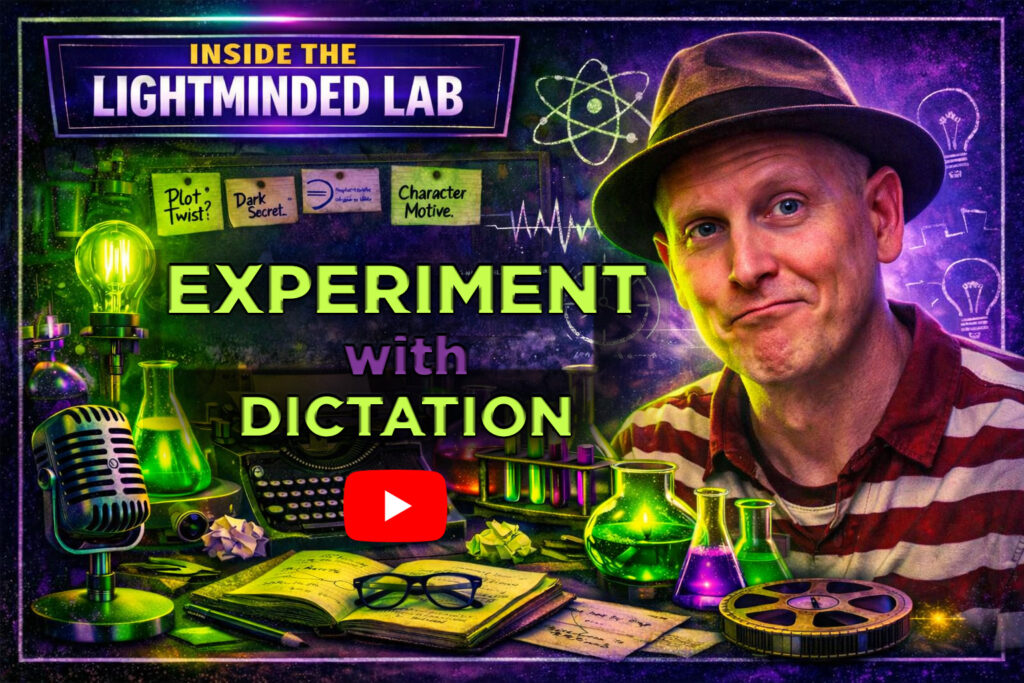
Welcome to the beginning of a brand new experiment in storytelling. I’ve been playing with dictation as a way to get more writing done in the little available time I have available.
As I discovered the power of dictation, I had this hairbrained idea to invite guests on my show, where we would brainstorm a story idea in only 10 minutes, then spend the rest of the hour dictating that story in all its raw glory for you.
Once done, that raw dictation will go through a few edits and polishes and be turned into a classic styled radio drama, and aired here on the podcast.
What the Light‑Minded Lab Is Trying to Do
The whole point of this side show is to explore storytelling in a way most people never try: Speaking stories out loud, in real time, without a script.
This is a powerful tool for those who give it a try. When I first thought of this, I had visions of an old show I’d once seen with a salty woman speaking sensual lines into a tape recorder while at the grocery store.
But what I’ve learned is that dictation is amazing, and I want to share it with you.
By the way, if you think you’re terrible at writing, or you want to get more time in dictating, you should read my latest book: Drafting Out Loud, A Creative’s Guide To Dictation, and it will help you do what I’ve learned to do here.
Check it out today, its now released and available in print, ebook, and audiobook!
Anyhow, here’s what I’m doing in this LightMinded Lab side show.
The show’s format is simple:
- 10 minutes to generate an idea
- 50 minutes to dictate a full story in one take
- Then I take that raw, unfiltered dictation and turn it into a polished radio‑drama episode
It’s part workshop, part performance, part creative dare. Because I’m teaching dictation as a craft, the show becomes a meta‑lesson: I’m demonstrating the method while using the method.
This episode is the first time the audience gets to see the entire pipeline in action. This is both to serve as an example of what it might look like for any guests, and for your enjoyment too, if you’re just following along.
By the way, if you bought my guidebook on dictation, you might note that this was also my final assignment in that book. If you’re interested in dictation, I suggest you buy the book. It will take you from 500 words a day on the keyboard to over 2000 words per day via dictation.
Where the Idea Came From (Rod Serling Would Be Proud)
When I sat down to brainstorm the story, I used the Rod Serling method, the same approach he might have used for The Twilight Zone (this is one of several methods we can use on our show):
- Start with something that bothers you.
- Turn it into a metaphor.
- Build a world where that metaphor feels natural.
- Add one anomaly that breaks everything.
So I asked myself:
What’s something that frustrates me?
And the answer came out before I could stop it:
“Political extremism.”
But I didn’t want to write a political story. I wanted to write a parable, something that felt true without naming the thing it was about. After all, that is how Serling avoided the censorship of the networks. So I turned extremism into something more universal and less divisive: extreme dieting.
A man who wants to lose weight while eating all he can. To do this he finds a miracle pill. But the promise of all you can eat led to a consequence he couldn’t undo.
The Dictation Session
If you listen to the show, you’ll see the truth of dictation. I stumbled some. But for the most part, I kept going, trying to tell a story as if you were sitting there listening to me. In the end it produced a rough draft. Granted this rough draft was very close to what the polished draft would eventually look like.
I mention it all the time. “We’re basically explaining a movie to someone who’s not there.”
For this story, I came up with a guy named Bernie, who had a simple desire:
- lose weight
- get noticed
- maybe get a date
- feel like his life matters
He’s lonely, overlooked, and short‑sighted, which makes him the perfect target for a miracle solution.
The story unfolds naturally:
- He tries the pill.
- It works.
- It works too well.
- He becomes a local celebrity.
- Then a national one.
- Then dangerously thin.
- Then terrified.
- Then desperate.
- Then… gone.
The final police call is quiet and chilling, but I’ll let you decide if it landed well for yourself. Check it out in the Archive.
Even though the story never mentions politics, it’s absolutely about extremism:
- the seduction of simple answers
- the danger of going “all in”
- the hunger for validation
- the blindness that comes with desperation
- the way society rewards spectacle
- the way individuals get consumed by movements they don’t understand
Bernie becomes a symbol and a warning.
Turning Dictation Into a Radio Drama
This is where the Lab’s mission really comes together.
The raw dictation is full of inperfections, visual descriptions, filler/filter words, and moments that don’t translate directly to audio. The radio‑drama edit has to do the opposite. I needed to replace visuals with sound cues, tighten pacing, clarify character voices, and fix a few spots that didn’t come across very well in the moment.
For example:
Dictation:
Bernie looks in the mirror and thinks about his life.
Radio drama:
SFX: Razor scraping. Water running.
BERNIE (muttering): “What have you done in the last twenty years…”
Same emotional beat.
Different medium.
Same story.
What This Episode Proves About the Light‑Minded Lab
This episode shows that:
✔️ Dictation can produce real, compelling stories.
✔️ Dictation forces clarity and honesty.
✔️ The radio‑drama adaptation gives the story a second life.
✔️ The Lab has a unique identity.
This isn’t just a writing show or a storytelling show. It’s a creative experiment that evolves in real time.
Final Thoughts
This episode isn’t just a story. It’s a proof of concept. It’s the blueprint for what the Light‑Minded Lab will become. If you would like to be a part of this, let me know. If you just want entertaining stories, I’ll be happy to supply them here. And if you want to learn more about dictation, check out my book. Its small, but if you follow the program in it, you can, like me, go from incompetence in dictating, to confidently telling a story, any story, on the spot.
Check out my previous attempt at this, and compare it to this attempt, and you’ll see how much my program helped me grow.
And it proves something important: Dictation isn’t a shortcut. It’s a craft. Another tool we storytellers can place in our toolbox. And when you trust it, it creates stories worth preserving.
By the way, if you were counting, and I was, That 50 minute dictation session equaled over 3900 words. Not bad for less than an hour.
Leave a Reply