
Recently I dictated a story called The Weight of Miracles. It’s the first story in what I’m calling Stories From the LightMinded Lab, and while I’m happy with the final result, getting there reminded me of something I’ve been wrestling with for years.
How do I write every day when I have so many side hustles pulling me in different directions?
Like a lot of writers, I’d get excited about a project, make progress for a while, then get pulled away by life, work, filmmaking, podcasts, family responsibilities, or whatever else happened to need my attention that week. I needed a way to keep creating even when I didn’t have the time or energy to sit in front of a keyboard for hours at a time.
That search eventually led me to dictation.
Unfortunately, I quickly discovered that dictation wasn’t nearly as easy as people make it sound.
When you’re typing, you can stop for a minute and think. You can stare at a paragraph. You can scroll back through previous chapters. You can make notes in the margin. You can spend ten minutes trying to figure out the perfect transition between two scenes. Dictation doesn’t really work that way. Once you’re talking, the easiest thing to do is keep talking. If you stop too often, the momentum disappears.
That became very obvious while I was creating The Weight of Miracles.
As I dictated the story, I found myself trying to keep track of John’s emotional state, the rules of the miracle, the reactions of the doctors and nurses, where the story might end, whether the pacing was working, whether I had established enough information for later scenes to pay off, and about a dozen other things all at the same time.
The interesting part is that none of those are really writing problems.
They’re dictation problems.
The story itself follows an EMT named John Stilton who discovers he can somehow keep dying people alive simply by being near them. It’s a simple premise, but simple premises often create complicated stories. Every new scene seemed to raise another question. Every solution seemed to create three new problems. I was constantly trying to stay ahead of the story while also trying not to lose the thread of what I had already established.
Looking back now, I can see that The Weight of Miracles taught me an important lesson. The challenge wasn’t finding ideas. The challenge was learning how to manage those ideas while speaking them out loud.
The funny thing is that I never intended to create a course or write a book about dictation. I was simply trying to solve my own problem. I wanted to spend less time fighting the creative process and more time actually creating stories.
Over time I started keeping notes. I paid attention to what worked and what didn’t. I experimented with different ways of outlining, different ways of preparing for a session, and different ways of recovering when I lost my train of thought halfway through a scene. Little by little, I started building a system that made dictation easier and more reliable.
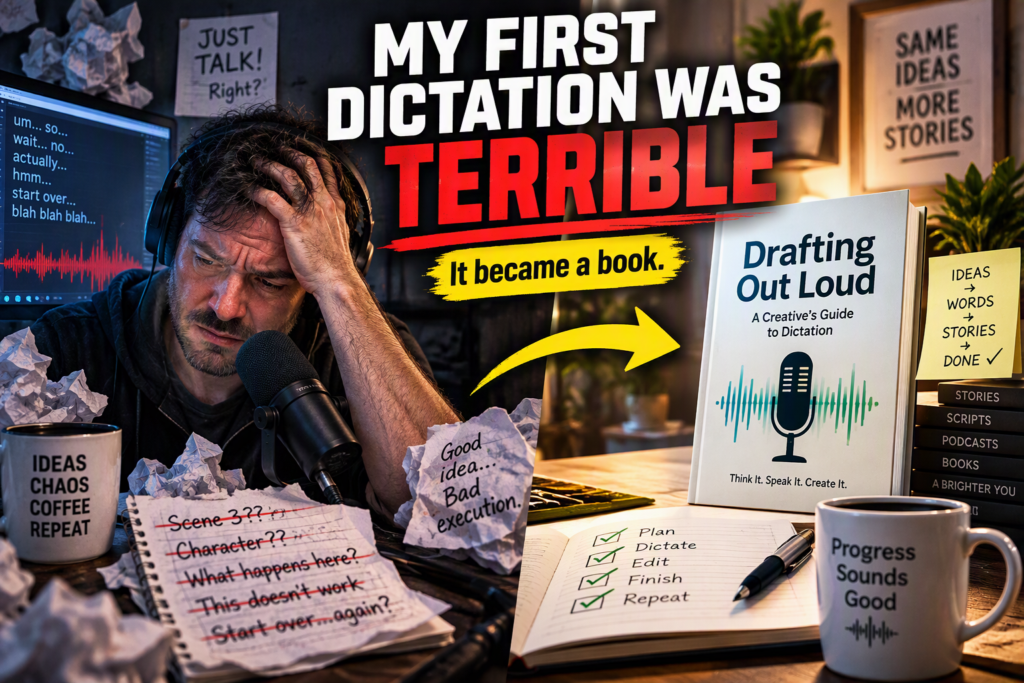
Eventually those notes, experiments, mistakes, and discoveries became something larger. That’s what ultimately led to my dictation course and eventually my book, Drafting Out Loud: A Creative’s Guide to Dictation.
What’s funny is that The Weight of Miracles was actually my first attempt at dictating a story. What came out of that original session was a mess. It took a lot of work to transform that dictation into a finished short story and eventually into the radio-style drama you can listen to on my podcast and YouTube channel.
In fact, you can still listen to the original dictation session if you’re curious.
It was rough.
Really rough.
Listening to it now, it’s honestly kind of amazing that The Weight of Miracles ever became a finished story at all. There are moments where I lose my train of thought, moments where I’m trying to figure out the next scene in real time, and plenty of examples of mistakes that beginning dictators tend to make. But that’s also what makes it interesting. You get to hear the story before it became a story.
You get to hear the creative process while it’s still messy.
If you’d like to try dictation yourself and avoid at least some of the mistakes I made along the way, check out Drafting Out Loud. It’s the book I wish I’d had when I started. Inside, I break down the techniques, exercises, and habits that helped me go from chaotic dictation sessions to actually finishing stories.
If your biggest challenge isn’t coming up with ideas but finding the time to write consistently, dictation might be worth exploring. It certainly changed the way I create.
And if nothing else, The Weight of Miracles proves that even a terrible dictation session can eventually become something worth sharing.
Leave a Reply