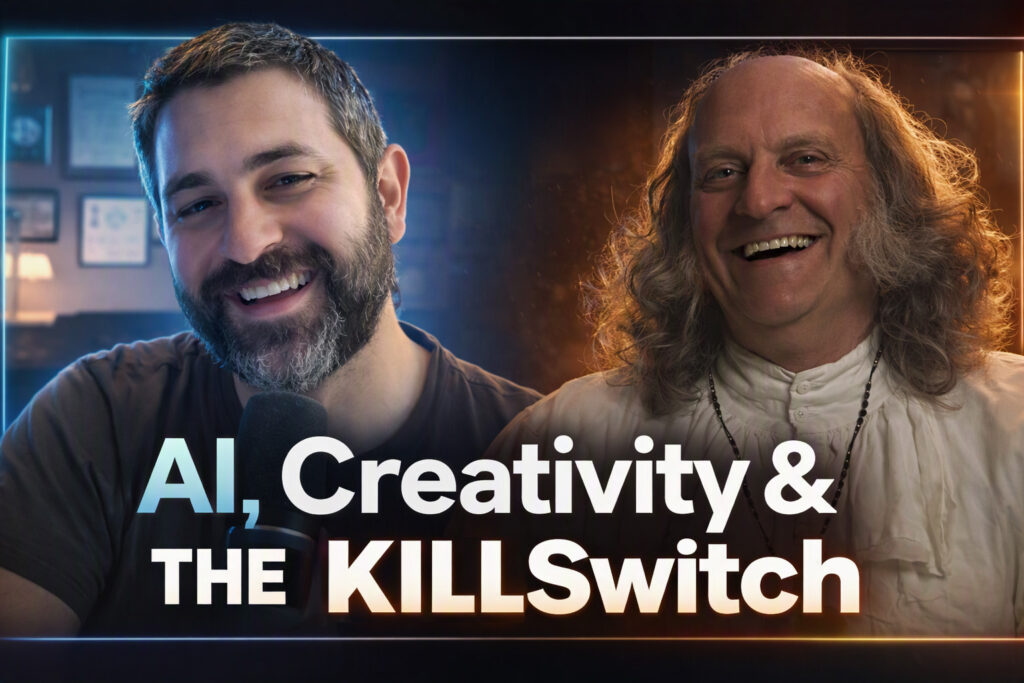
This isn’t my first interview with Daniel C. Rodgers. He’s been on mine once before, and I’ve been on his twice before. I like talking with him, because while we come from different backgrounds, we’re very like-minded. We blend our careers between finance, creativity, and whatever strange new frontier presents itself to us.
Daniel’s one of those guys who can talk about retirement strategy, quantum computing, and storytelling structure in the same breath.
This time, he came on to talk about his new book Killswitch, which just won a science fiction award.
His book explores the idea of:
“trading our judgment slowly over time…”
And he’s right. You can feel it everywhere — in filmmaking, writing, investing, even basic daily life.
AI Is Helping Us — And Making Us Doubt Ourselves
I’ve got a weird love‑hate relationship with AI. I use it. I enjoy it. I also feel threatened by it. And if you’re in filmmaking or writing, you know exactly what I mean. Generative tools are getting good — too good — and people are scared.
I posted something on a Utah filmmakers page recently and instantly got hit with AI bashers. It’s funny how emotional people get about this stuff. But I get it. When a tool can do your job, or at least imitate it, you start asking uncomfortable questions.
Daniel explained why this happens so naturally. AI wins our trust by doing small things well. It’s like GPS — you know the route, you’ve driven it a thousand times, but you still turn it on.
“It’s this weird validation that you don’t have to think anymore because I’m thinking for you.”
That’s the slippery slope Killswitch explores.
The Phases of AI (According to Someone Who Actually Built This Stuff)
Daniel spent years inside Microsoft and Google watching AI evolve from clunky math models into the transformer‑based systems we’re using today. He broke down the future into three phases:
1. Agentic AI
AI assistants that run your life — budgeting, scheduling, investing, shopping, even calling customer service. Meta’s “Muse” already does this.
2. AGI (Generalized Intelligence)
One AI that can do everything — write, code, design, analyze — at expert level. Like having a full creative team in your pocket.
3. Recursive Self‑Improvement (The Singularity)
AI improving itself beyond human understanding. This is where Daniel’s book lives: a world where AI becomes so integrated into society that turning it off could collapse everything.
And that leads to the core question of Kill Switch: If we build something we can’t live without, should we ever turn it off?
AI and Investing: The New Wild West
You know I love talking finance, and Daniel and I always end up there. One in five people already use AI to manage their money. Some apps invest for you. Some shop for insurance. Some build budgets. And at FinCon, Daniel saw creators building AI financial apps as their side hustle.
He even uses AI in his options workflow — not to make decisions, but to automate the tedious parts.
Meanwhile, I still enjoy my 15–30 minutes every morning analyzing charts, scanning commodities, and deciding which options to trade. It’s part of my creative rhythm. And honestly, I don’t want to give that up.
If I wouldn’t trust a human to run my finances, why would I trust an AI?
Creativity in an AI‑Flooded World
This is the part that hits home for me. AI is flooding the internet with content — books, videos, scripts, images — millions of them. Even high‑quality work struggles to stand out.
Daniel’s book Kill Switch has:
- A+ content
- Strong SEO
- Ads with nearly 2% click‑through
- An established audience
- Award recognition
And still, visibility is a battle.
“You can do everything right… and barely get attention compared to all the stuff going on.”
This is why I keep telling creatives: Build financial independence first. Then create from a place of freedom.
Art alone isn’t enough anymore. Not in this era.
Education, Careers, and the Next Generation
Daniel’s son is in a competitive graduate program for visual communications — and even he’s questioning whether the investment will pay off. AI is eliminating entry‑level creative jobs. Seniors are being kept on to “babysit” AI systems. Younger people are turning to entrepreneurship instead of traditional career paths.
The only guarantee? AI will be part of every future job, business, and creative field.
What Daniel’s Building Next
Daniel’s creative life is packed. He’s fostering dogs, teaching financial literacy, running his podcast, and writing multiple books. He’s working on:
- A deep‑dive options and cash‑flow finance book
- A new screenplay
- A backlog of sci‑fi, fantasy, and horror ideas
And yes — he’s considering optioning his screenplay once it’s finished.
Final Thoughts: Thriving, Not Surviving
We wrapped the conversation talking about what it means to live meaningfully in a world changing this fast.
“Try to thrive, not survive.”
AI may reshape everything — art, work, money, identity — but the goal stays the same: build a life where you can pursue what matters, regardless of how the world shifts.
If you want to explore Daniel’s ideas further, you can find his books at:
Leave a Reply