
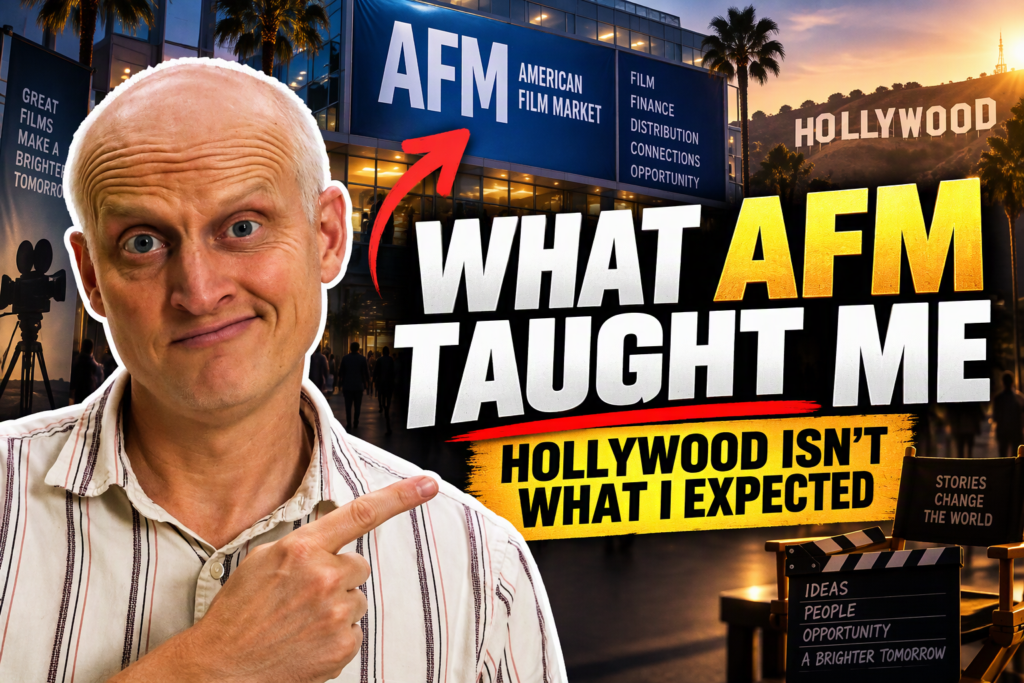
Last week I attended the American Film Market (AFM), and it was unlike any convention I’ve ever been to.
Most of my convention experience comes from the construction industry, where trade shows tend to be highly competitive. AFM was different. It was intense, busy, and very much a marketplace, but it was also surprisingly collaborative. Filmmakers from around the world gathered not just to sell movies, but to connect, learn, and explore where the industry is headed.
I came away with several key takeaways. Some of them may be controversial, but they genuinely reflect what I saw and heard during my time there.
1. Hollywood Isn’t Afraid of AI
Let’s start with the elephant in the room.
AI remains one of the most divisive topics among artists. Some creators are embracing it wholeheartedly, while others see it as a threat to everything creative.
What surprised me at AFM was how little fear I encountered.
Aside from one attendee who visibly walked out of a session when AI was mentioned, nearly everyone I spoke with saw AI as a tool rather than an existential threat. Production companies, software developers, filmmakers, and visual effects artists were all discussing practical ways to use it.
The important distinction is that most professionals aren’t talking about replacing creativity. They’re talking about improving workflows.
Think about modern editing software. Adobe, DaVinci Resolve, and After Effects already incorporate AI-powered features. Rotoscoping, object tracking, masking, noise reduction, and countless other tasks now rely on machine learning in ways many users don’t even think about.
In the VFX world, AI is increasingly being used to accelerate work that artists were already doing manually. Rather than replacing artists, it’s helping them create faster and more efficiently.
A good example would be designing a visual effect yourself and then using AI-assisted tools to handle tedious frame-by-frame interpolation. The artist still creates the vision. The software simply helps execute it.
- My biggest takeaway was this:
The filmmakers who embrace these tools will likely adapt and thrive. The ones who refuse to learn them may find themselves left behind.
Just as digital editing replaced film splicers, AI will become another standard part of the filmmaking toolkit.
2. Authentic Creativity Matters More Than Ever
Ironically, the rise of AI may make originality even more important.
What I repeatedly saw at AFM was a belief that audiences still crave unique voices, distinct stories, and personal visions.
Technology can help create content, but it cannot replace perspective.
The creators who stand out will be the ones bringing something genuinely new to the table. AI may lower technical barriers, but it doesn’t eliminate the need for imagination, storytelling, or artistic vision.
If you’re worried about AI replacing artists, my advice would be simple:
Lean into what only you can create.
Your experiences, your voice, and your stories remain your greatest competitive advantage.
3. Actors Aren’t Going Anywhere
One concern that comes up frequently is whether AI will eventually replace performers.
Personally, I don’t see that happening. What I see instead is a future where actors and AI-powered workflows collaborate more closely.
Actors provide something that algorithms still struggle to reproduce: authentic human performance.
Whether a film is live-action, animated, or something in between, audiences respond to genuine emotion and believable performances. Technology may enhance what’s on screen, but it still needs compelling human input.
In fact, some emerging workflows actually give actors more influence over animated productions by allowing their performances to drive character animation directly.
The technology may change, but performance still matters.
4. Vertical Films Are Becoming a Real Market
One of the most fascinating trends I encountered was the rise of vertical filmmaking.
For years, filmmakers told people to rotate their phones sideways when recording video. Now entire films are being designed specifically for vertical viewing.
Platforms like TikTok and Instagram have created audiences that are comfortable consuming stories one short segment at a time. Some creators are building serialized films that unfold through dozens of vertical clips.
Many of these projects are generating millions of views.
Traditional filmmakers sometimes dismiss the format, but audiences clearly aren’t.
The lesson here isn’t that traditional filmmaking is dying. It’s that new formats are creating opportunities for creators who are willing to experiment.
If you’re looking for a lower-cost way to start building an audience and telling stories, vertical filmmaking is worth paying attention to.
5. Don’t Count on Minimum Guarantees
One of the more sobering lessons from AFM involved distribution economics.
The general sentiment I heard was that minimum guarantees are becoming increasingly rare.
With so much content competing for attention, distributors appear hesitant to take on as much financial risk as they once did.
That means filmmakers may need to:
- Raise more equity financing
- Utilize production incentives
- Reduce production costs
- Think more strategically about distribution from the beginning
Film incentives were frequently discussed as one of the strongest forms of soft money available today. Depending on where you shoot, rebates and tax incentives can significantly impact your budget.
The days of relying on a lucrative distribution deal to rescue a project seem increasingly uncertain.
6. Distribution Should Be Planned Before Production
Another major realization was just how important distribution strategy has become.
Many filmmakers approach distribution as something they’ll figure out after their movie is finished.
That mindset can be dangerous.
Before making a film, you need to answer some difficult questions:
- Who is the audience?
- Where will they watch it?
- How will they discover it?
- What budget can that audience realistically support?
One of the biggest mistakes independent filmmakers make is believing their movie is “for everyone.”
Most movies aren’t.
The most successful projects understand exactly who they’re for and build every major decision around serving that audience.
Distribution isn’t something that happens after production anymore. In many ways, it starts before you write page one.
7. AFM Is a Marketplace
I attended AFM without a finished film.
If you’re considering doing the same, here’s something important to understand:
Most distributors and sales agents are there to buy and sell completed projects. They’re busy making deals.
Many of the meetings I hoped to secure never happened because they weren’t interested in discussing unfinished projects during the market itself. However, I also learned something encouraging. Many of those same companies were happy to exchange cards and invited future conversations after AFM ended.
In other words:
AFM isn’t always the best place for development discussions. It’s a great place to make introductions, establish relationships, and identify who you should follow up with later.
8. The Money Isn’t Always Where You Think It Is
One analogy kept coming to mind throughout the market. During the Gold Rush, most miners didn’t become wealthy. The people who made consistent money were often the ones selling picks and shovels.
Filmmaking can feel similar.
Many companies serving filmmakers seem to be generating more reliable income than the filmmakers themselves. Software companies, equipment providers, distributors, aggregators, and service businesses often earn predictable revenue regardless of which individual movies succeed.
That doesn’t mean filmmaking isn’t worth pursuing. It simply means filmmakers need to approach their projects with realistic business expectations and understand where value is actually being created in the industry.
9. The Best Part of AFM Was the People
Despite all the conversations about technology, distribution, and financing, my favorite part of AFM wasn’t the business side. It was the people.
I met filmmakers from Romania, France, Germany, Canada, a bunch from Los Angeles, and many other places. Nearly everyone was approachable, curious, and willing to share their experiences.
What struck me most was how collaborative the environment felt. Artists may fiercely protect their work, but they’re often surprisingly generous with each other. I left with a stack of business cards, future collaborators, and a long list of conversations I’d like to continue.
If I attend AFM again, I think I’ll place even greater emphasis on building relationships. Those connections may end up being more valuable than anything else I gained from the event.
One Practical Tip for Future AFM Attendees
- Bring physical business cards.
Seriously.
Several people exchanged contact information digitally, and some of those contacts have already disappeared into the void of my phone. The people who handed me physical cards are the ones I can actually follow up with.
- Even more important, keep a notebook or journal.
After every conversation, jot down:
- The person’s name
- What project they were working on
- Something memorable about them and your discussion
When you return home with a stack of cards, those notes become invaluable.
Final Thoughts
AFM challenged several assumptions I had about the film industry.
AI is being embraced more than feared. Vertical storytelling is becoming legitimate. Distribution remains one of the biggest obstacles facing independent filmmakers. And perhaps most importantly, relationships still matter.
The future of filmmaking is changing rapidly, but the fundamentals remain surprisingly familiar: tell a good story, understand your audience, treat filmmaking like a business, and build genuine relationships along the way.
Everything else is just tools.
Leave a Reply