Light Minded Arts

Light Minded Arts

  • B-Roll
  • Books
  • Videos
  • About
  • Contact

Home | Archives for Lexi Adams

Coming up with a good plot for your story is one of the most essential things you can do for your book. Of course there’s other things too, like developing a good character, world building, and so on, but without plot, your book or film is dead on arrival.

Coming up with a good story plot however doesn’t happen easily. Some plots are also going to be more suited for certain genres, some for long form stories, some for short.

Then there’s also the debate over whether or not you should follow a specific structure or outline that is based off of someone’s “proven” method. Others will say that if you’re following any story structure at all, then you’re not being true to yourself as an artist.

I have some real thoughts here, and I’ll share those with you today, I’ll be mostly talking with you about the structure aspect of plot.

How Important Are The Guru’s Story Structures?

If you haven’t heard of them yet, you doubtless will as you progress, but there are many guru’s out there who will tell you how to structure your story. From Blake Snyder’s “Save The Cat” to Joseph Campbell’s “The Hero’s Journey,” and several others between and around, you’ll find definitive methods for what to say on which page of your book or screenplay.

You’ve also heard of the 3 act story structure, the wheel, and possibly others. Who is right?

Can’t you just start writing your book, pantsing your way through until you come to the end of the story?

Here’s the thing, experimental story structure is ok, if you want to experiment. If you want to make money on your stories, adhering to a proven structure, even if loosely is going to be important.

Human’s are story loving creatures. We’ve been conditioned over thousands of years to respond to stories. If your story doesn’t receive the sort of response you think it deserves, then maybe your structure is too outside the norm for most people to relate with.

For this reason, I believe that following proven methods are important. I don’t think a strict and rigid adherence is completely necessary, but a story should have a beginning, middle, and end. But every form of art should tell some story.

How would you apply the Hero’s journey to a painting? Or Save The Cat to a sitcom, song, or novel? What about short stories? There is not single approach that hits all of these different story forms. But understanding that your plot still needs a recognizable format is still essential if you are to find any impact with your audience. At least its important if you want to make any money with your art.

How to Structure Your Plot

Have you ever heard the saying, “Only once you’ve learned the rules, can you break them.”

This is how structure works. When I’m plotting a book, I’ll find a structure that suits the format of my story. I’ll then lay out the essential beats of that story in a way that best tells the story in the genre that I’m going for.

By the way, if you’re like me, and you hear the term “Beats” and it confuses you, I get it. It took me a long time before I understood what that meant. I’ll discuss that in my next article, so check back next week for more on that, but for now, we’ll stick with structure.

Once I have my book outlined, with the structure that makes the most sense, I’ll start writing. One thing I’ve learned though, is that even if you have what seems like a perfect structure, by the time you finish your rough draft, it doesn’t always feel right, yet.

That is because my original plot either had holes in it, or as I was writing, my imagination took me in a few different directions that either helped or hurt the story, but now need to be reconciled in the greater whole.

This happens whether you are plotting your way through a story or pantsing your way through it. If you haven’t realized by now, I tend to work more on my plot before I write, rather than just taking an idea and writing by the seat of my pants (pantsing).

So my ugly rough draft is done, and this is where I take my rough draft and turn it into my first good draft. I’ll read through it, outline what is happening in the book, and making judgments based on what I know of story structure, plots, and beats, to make a story that works.

I think of it like this. My rough draft is like going to the quarry and chiseling out a large block of stone.

My next draft, is where I take that stone, roughly the right dimensions, and I chisel out the majority of waste till I have a very rough shape of my statue.

From there, future drafts will be honing the statue into its most pure form, but I have to get the thing looking roughly like it should first.

Then once you’ve got the shape of your story, you are ready to add color and edit it. A note on breaking the rules. This can be a fun way to subvert expectations, and give the reader something unpredictable. Be careful though. This isn’t something that you should do, willy-nilly. Especially as a beginner, you need to know how breaking those rules might affect your audience.

Often transcending any given story structure is less about being experimental, than it is about adding layers of depth to your story.

Where To Start Learning About Structure

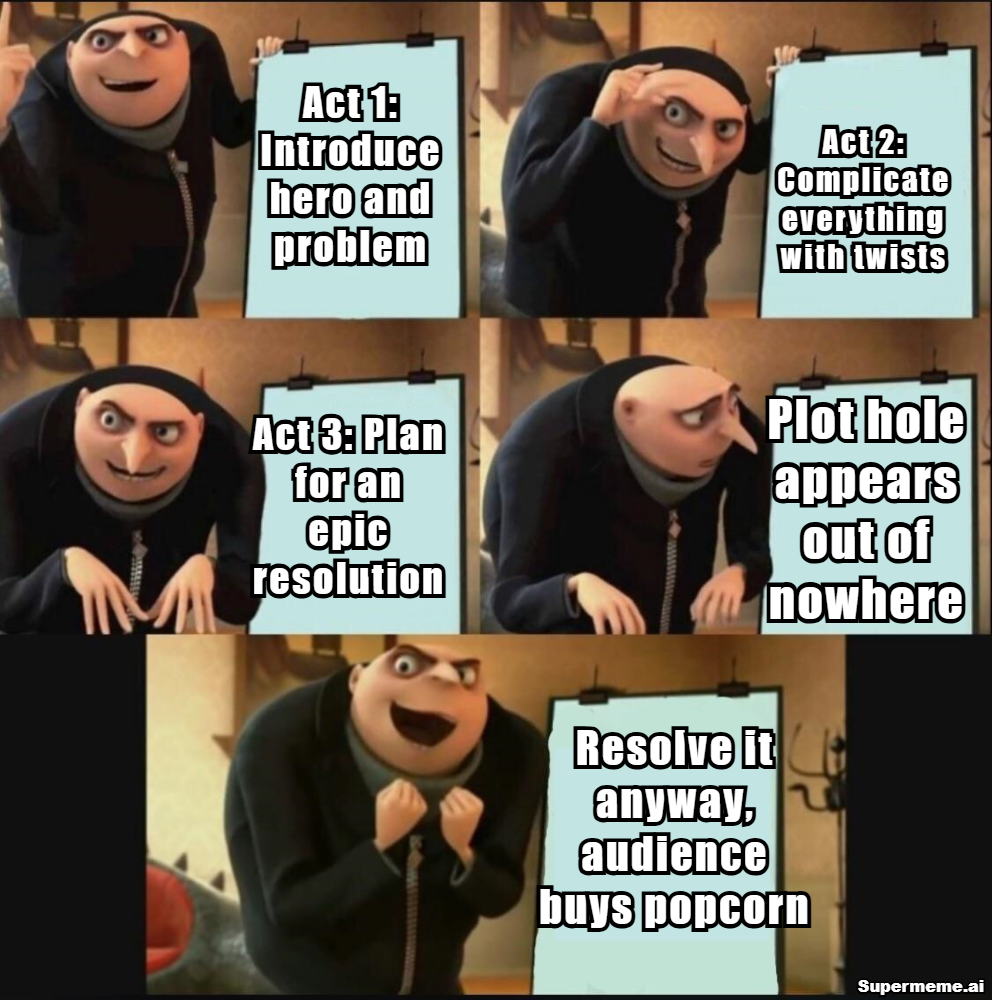
If you’re a beginning writer, keep it simple. The 3-act story structure is the most proven out there. Frankly, a lot of other story structures, if inspected, are still 3-act structures. Base your plot on the following:

Act 1: Beginning. You learn about your character

You have some sort of inciting incident

You have some way of breaking into act 2

Act 2: Fun and Games. Your character hits multiple obstacles, each leading up to

Act 2: Midpoint. This is some kind of twist. Followed by more obstacles. 

At the end of Act 2, you find some sort of climax

Act 3: You work through your climax, but don’t solve it yet. You need to enter that “Dark night of the soul, when things are at their worst.

Then you can find a way to overcome all, and wrap up your story.

Act 1 should last about ¼ of your story. Act 2 should be a good ½ of your story. Act 3 should last about the last ¼ of your story.

Another type of story structure you could look into are circle stories, where the story ends where it began. Let me know if you have any other structures you like to tell stories in.

Regardless of your genre, this will get you started. The next thing to learn will be genre beats. Entire books have been written on this topic, and many people confuse structure with beats. So in a future article, I’ll point you in the right direction, but if you’ve gotten this far, good job. Learning to tell your story based off proven methods isn’t discounting yourself as an artist. Even an oil painter needs to know their technique before they can create art. They might add their own flare eventually, but technique is still a part of any art form, including story structure and plot.

To find more, visit my YouTube channel on this topic at: https://youtu.be/UBL8fyOwqW8

Filed Under: Blog

Last time, we talked all about the costs involved in writing and finishing your book. If you missed that article, check it out, it goes into the financial costs of self-publishing your own book.

Today though, we have the monumental task of breaking down the biggest problem of all, marketing your book. Because let’s face it, with time and expense you put into your book, you really ought to get something out of it, right?

But wait, where do you start? How do you budget this? Can you track it?

It’s not at all simple, but you don’t have to be a professional marketer to do it either. Just keep in mind, that this isn’t your primary job. That belongs to writing. This is just one of those essential tasks that needs to happen to get eyeballs on your book.

Self-Marketing Your Self-Published Book

Marketing your self-published book could take up many articles, and maybe we’ll discuss this more in some future posts, however, today, I want to focus on the financial aspects of marketing.

From Part 1 of this financial study, you may remember that we estimated your theoretical writing career to cost approximately $33k per year. The goal here, is to make enough money to break even, then start generating a profit. To do this, we have to understand how much money we’re actually making.

When I publish my novels, I try to keep their price competitive with the market. That means that I often only have a profit margin of between $1.75 to $2.00 (we’ll stick with $1.75/book for now) per book sold. That doesn’t sound like a lot, but if you were to be traditionally published, that would go down to about $0.35 to $0.45. The difference is, they can print and sell more volume.

That brings us to your goal, sell enough volume that we can be happy with our return. There’s two ways to do this, well, l three actually, but I don’t recommend the third.

Three ways of Selling your book:

  1. Setting a target for number of books sold. This means you put a goal out there, and work backwards from that to get to your budget number.
  2. Set a marketing budget, and add money to it as you see results.
  3. Print as many books as you can afford, then sell them in person.

The reason I don’t like this third option, is because it involves hassling friends, family, and becoming a door-to-door salesman. It can work, but it turns you into a salesman rather than a writer, and once you’re done, you’re done. There are no algorithms to push your books to other interested parties, there’s no repeat business, it’s over.

Option number one, isn’t bad either, however, it works best, once you’ve already figured out a strategy for predictable sales, given your style of marketing.

That is why I prefer to start out with the second option. So lets break it down.

Budgeting and Exploratory Marketing

You have $1.75 per book to work with. So it makes sense that you won’t want to spend all of that profit on marketing. What is the happy medium? For me, if I were to make half of that in profit, so $0.88, that would mean that I would have to sell 37,500 books to break even. That sounds doable to me.

Keep in mind, that we aren’t targeting 37,500, we’re just saying that we think that is achievable, given the market our book might be selling in. You might adjust this contribution according to your personal thoughts on the matter, but we’ll stick with this for this example.

So if we are making $0.88 per book, that means that we are willing to spend $0.87 for every book sold. That is great, because we now have a budget we are comfortable with.

Let’s next look at how to spend that $0.87.

Let’s start with the cheapest forms of marketing, and work our way up. Keep in mind that all of this still requires some time from you, and my biggest word of caution, I’ll say it again, don’t let the task of marketing take over your career of writing. Budget your time accordingly.

First- Get your metadata right when you fill out your ISBN and distribution information. It only takes minutes to do, but it should be accurate.

Friends and Family- This can be by word of mouth and social media. Obviously, enlisting them if possible, will be a great way to get started. It’s free, but it doesn’t have a very far reach. Chances are, you’re not going to sell more than a couple hundred books this way, and even that is only likely if you’re well connected and liked.

Goodreads- I’m not talking about pitching your book to every group on there. But rather, go to their give-a-ways section. That’s right, I’m asking you to give away some of your books. The reason is, that people on Goodreads, love to read, a lot. And when you sign up to possibly win a free book on Goodreads, if they’re actually interested in it, they’ll add it to their wish list, and if they lose the bid, they might still see the book and decide to buy it later. But also, winners are highly encouraged to leave reviews, which in turn can help drive your sales. This can be free too, if you’re giving away ebooks. However, if you also try to give a few physical copies away, you tend to get more interest in your book, but that costs money and you need to be careful. I’ve done this and been dinged by high shipping costs to international destinations. But for now, we’ll call this a free option.

Book Bloggers- Now we’re starting to get into spending. Look for bloggers who review books  like yours, and ask them to read yours. They’ll charge you a little for their review, though some might do it for just a physical copy, the ones with influence will probably cost at least $200. Keep in mind though, the ones with good followings can really help push your book to a large audience, if the blogger actually likes it. Keep in mind, if only your mother liked this book, you might not want to have it reviewed, as these people will give their honest opinion.

Paid Online and Social Media ads- These are usually sent through Facebook, Google Ads, Goodreads, and others. They are keyword driven, and demographics driven. You may think it’s creepy that marketers all seem to know who you are, but now you get to leverage their massive databases to your advantage. Start small, give yourself a little budget and experiment. Do a weeklong ad campaign and see if your sales and budget align. If you find that you’re spending more than $0.87 for each sale, then change it up. This is where you need to experiment a little until you find a sweet spot where your spend is under your budget for the number of books you sell. So keep a spreadsheet, and track your ad spend and your books sales on a weekly basis so you know what is and isn’t working for you.

Billboards, Radio, Talk Shows- Are you comfortable shelling out more money and playing with the big boys? Getting on the Today show might catapult your book, unless you find yourself completely uncomfortable in front of a camera. Radio is easier, because you can pre-record your ad, or you can join in as a special guest. Both of these will cost you money to get into. You might need to hire a publicist for the talk shows, but for radio, you can set a budget and a campaign. Depending on the radio station and its reach, you should probably plan a minimum budget of $2000, with an upper limit of $10,000. Keep in mind that if you pay $10k, it had better result in at least 11,500 sales to make it worth the spend. If you don’t think that station has that kind of influence, spend your money elsewhere. Billboards are similar. In a high traffic area, you might spend between $8,500 to $10,500 per month, less if you get on a digital billboard that rotates through other people’s ads every 30 seconds. This is good, as it creates repetitive views, but only about 5% of billboards are designed in a way that actually works, so be very sure that you have what it takes to design a winning billboard if you go this route.

The Numbers Can Lie

Marketing is so hard. As the saying goes, “Only half of it works, I just don’t know which half.” Plus, some effort you put in one area may take time to be effective, and you may attribute your current sales to the wrong marketing model.

One thing is clear though, marketing is a necessary evil. Take your time. Don’t rush it, keep track of your budget, and increase it as your books sell. Also, as you keep writing new books, the old books will start to serve as marketing for newer books. Your fans will start to generate their own marketing for you. But even then, it won’t be over. Then you’ll want to do books signings and make other efforts to strengthen them. The time you decide you don’t need to market your books anymore, is the time your sales will start to fall again.

Check out my video on this topic at: https://youtu.be/bXJXhF9fsB8

Filed Under: Blog

If you’ve been following my other posts, you should have a pretty good idea of my process for writing and publishing a book. That’s all good to know, even if you have a process that differs from mine.

What you don’t know yet, is how the financial side of all this works out, because let’s face it, the world revolves around money, and when you create works of art for income, you have to look at the business of this, too.

Buckle up, because this is going to be full of numbers, and if you’re not comfortable with that, then it might take a few reads to get familiar with this. Keep in mind that these numbers can vary depending on you, who you hire, and other factors.

Hard and Soft Costs

First, let’s distinguish between hard and soft costs. What do I mean by a hard cost? Well, this is any cost that you actually have to shell out cash for. This is going to be for people you hire to edit your book, or costs to print copies of your book—things that actually require money in the bank to honor.

Soft costs are those incurred by you spending your time working on them. Let’s face it, time is money, and even though you aren’t paying yourself to write, your time spent on that book does come at a cost. After all, you could be spending that time working a part-time job, or doing something else. Your time is worth something.

There is one other cost that we should probably consider, though I don’t think I’ll be able to put a number on everyone’s situation perfectly, but it something you can factor in the back of your mind, and that is Overhead costs. This includes things that I’ll assume you already have, like a computer, and the software needed to write your books. It includes the electricity to run your office, even if it’s a home office. 

The Breakdown

Overhead: If I write $0 here, it’s because I’m assuming you already own this and can use it, rather than buying new.

Computer- $0

Word processing software- $0

Adobe creative suite- $60/month or $720/yr

Electricity- $0 (judge whether or not you’d be using similar power when not writing)

Educational books- $50/yr (I recommend reading as much as you can about your craft)

Overhead subtotal = $720/yr

Hard costs of 1 book. (Assume it is a 100,000 word book. Adjust yours accordingly)

AI subscription- $0 (because you shouldn’t be using this to write your book!)

Copy edit- $4000 ($.03 to $.05 per word, depending on who you hire)

Proof edit- $2000 (this is about half the cost of a copy edit, if you hire someone)

Print proofreading manuscript- $40 (I like to do this for my proof editing)

Print proofreading manuscript again- $40 (because you missed stuff in your first proof edit)

Cover art- $500-$750

Hire Voiceover artist $1600 (optional but highly recommended)

ISBN numbers- $75 (buy in bulk and you get them for cheap)

Copyright submission- $45

Print review copy of book- $25 (includes shipping)

Print final copy of books- $100 (assuming you order a few copies for family/friends)

Subtotal Hard costs of making a book = $8425

Soft Costs of 1 book: (assuming you write 800 words/day or 2 hours/day, 5 days a week and your time is worth $25/hr)

1st Draft- $1250 (aprox 1 month) rough draft

2nd draft- $1250 (aprox 1 month) plot fixing draft

3rd draft- $625 (a couple weeks) early polishing draft

4th draft- $1250 (approx 1 month) after getting it back from copy edit)

5th draft- $625 (a couple weeks) revising and polishing

6th draft- $625 (a couple weeks) polishing draft

7th draft- $625 (a couple weeks) proof editing (if done by you)

8th draft- $625 (a couple weeks) proof editing again (because you will have missed stuff)

Other drafts – we’ll assume you’re good now, but I’ve done up to 12 drafts before.

Finding voiceover, Listening to, and noting edits for audiobook- $300

Organizing in Indesign- $200

Assembling cover art in photoshop- $200

Submitting manuscript to the Copyright office and the Library of Congress- $50

Filling out forms for ISBN numbers, Print on Demand, and Audiobook metadata- $100

Subtotal of soft costs = $7725

Assume that on this schedule you are writing two books per year. I assume this, because if you’re just starting out, you’re probably doing this all part time, and not full time, so this might be all the time you can afford to write your books.

Total costs (hard and soft + overhead) = $33020

Writing Books is Not Free From Costs

Thats a lot of money. Even if you only include the hard costs, that can add up pretty quickly.

If you’re like most of us, and just starting out, it’s easy to ignore the costs of our time, and focus on the hard costs. This is fine in the beginning, especially if you have a more steady income. But don’t shortchange your time spent writing either. Especially as you start doing more of it.

We haven’t even talked about the costs of marketing your book yet. Because making a profit on $33k worth of books in a given year won’t happen until you can start selling your books.

A lot of this work will also involve soft costs and hard costs. But I worry that I’ve overwhelmed you with the sheer cost of writing a book. So let’s save the marketing discussion for next time.

Check out the video I made for this topic. As I often do, I put a fun skit in there too: https://youtu.be/io0AgEhRxQQ

Filed Under: Blog

I used to read, a lot. Eventually, life started to get in the way of my pleasure reading. I’d still read to learn in the evenings, but reading for entertainment sake got harder as the years went on.

First there was work, then family, then more family and more work. Did I mention homeownership? Maintaining a house takes up a lot of time too. Good grief, how does anyone find time to read for pleasure anymore?

Then audiobooks came along. Granted, there were always books on tape or cd, but now they are digital. You can have them on your phone, wherever you go. It’s amazing.

These days, rather than listen to the radio, I listen to audiobooks while I’m commuting. I have to admit, that I find myself beginning to get too lazy to sit down and read a regular book.

In fact, I believe that audiobooks are cannibalizing the written book market to a large extent. So as a writer, what do you do about it?

Make audio books or get left behind

As a self-published author, you’ll find that getting your book turned into an audiobook is not all that difficult compared to getting your book published in print. However, it can still cost a little more time and money to get done.

If your publishing process is at all like mine, then you’ve likely already spent somewhere between $2000-$4000 getting your book made. That includes sending it out to editors and getting covers designed.

Hopefully when you got your cover designed, you also had them make you square version of your cover, since the standard rectangle for your book is not the same format used for your audiobook thumbnail, and let’s face it, stretching your image to fit a square format looks stupid.

To get your audiobook recorded, you should also plan on spending another couple thousand dollars for a professional voiceover artist. You could try AI, though last I checked, not all platforms that sell audiobooks will allow AI recorded books. Another thing I’ve noticed, when I’ve listened to AI recorded audiobooks, is that while the AI can get really close to sounding authentic, there’s always a few spots in every chapter where the inflections are slightly off, or words are pronounced weird, and it tends to throw me out of the story when I hear them.

That’s why I encourage hiring a voice actor. Now you can do this in two different ways. One is by offering them royalties on every download, and another way is to pay them a one-time fee to produce your novel.

For me, I prefer to do the one-time fee. That way, I don’t have to keep track of my sales and royalty payments. Authors with a larger customer base might warrant getting a voice actor to charge a royalty, but I’m going to assume that if you’re self-publishing that you don’t want to go this route. While sticking to a single platform like ACX might help with royalties (might being the key word, because I don’t know this for sure), the method I use and recommend is a little harder to automate royalty payments.

My Process

Generally, around the time that I start working on my cover art for my book, I start looking for a voiceover artist. If you don’t know my self-publishing method, check out my last article on publishing.

Anyhow, by starting this early, I’m able to give my voiceover artist time they need to record, and then my distribution provider time they need. Funny thing is, sometimes the distribution needs as much or more time than the voice actor.

My first two attempts at recording my book went poorly. First, I had a family member who offered to do this for me. He’d never done it before, but he had a dynamic voice and enthusiasm to accomplish the project.

He’d occasionally give me updates, until he didn’t. After a few months, I realized that he lost his drive to make it happen. The novelty had worn off, and I think he may have realized that my book at the time wasn’t all that worthy of his time, especially since I don’t think he planned on charging me for it. I think he just wanted to see if he could do it. I don’t fault him for giving up on it, especially after my second attempt to get it recorded.

For my second attempt, I tried recording it myself. Something you learn very quickly, is that no matter what time of day you decide to record, someone is going to start up a lawn mower near you, or drive a loud motorcycle past your street, or one of your kids is going to start making a racket. Then when you’re sure you have the time and quiet, your voice gives out. Unless you have a sound studio in your house, it can get really hard to record good audio. It takes planning and know-how.

So my first two attempts failed, and I gave up on that book. The third time I decided to do this the right way.

I hired a voice artist. I really like Voices.com for this. They have several voice actors, all with searchable characteristics and samples of their work. I used them to find a great voice actor for my book, One For The Money, Two For The Soul.

She was able to take my book and have it recorded and back to me in about a week. I listened to the files, added a file of my own “from the author” and had her fix a couple minor spots, then it was ready. Also, she recorded it in a format that would be acceptable on all platforms, and most importantly, Amazon’s Audible platform, which has some specific quality requirements.

Next I chose to use FindawayVoices.com for my distribution. I could have just used audible, but like my book publishing philosophy, I really like being available on as many platforms as possible, not just Amazon’s exclusive stuff.

With Findaway, I was able to get mass distribution to everyone, including Audible, however you need to have everything uploaded, and finalized with a release date posted at least a month or two at the minimum in advance, because it does take some time for all the retailers of your book to get the listing from Findaway on their databases.

Once you’ve completed this step, congratulations, you’ve done it. You now have your book published in print, digital, and audio formats. What’s left?

Well, there’s two things. Marketing and doing it all over again. But those are topics for another discussion.

For more fun and helpful content, visit my YouTube channel. This topic, along with a short skit, can be found at: https://youtu.be/1k8kqJTkyOk

Filed Under: Blog

Way to go, you wrote your first book, published it, maybe. What next? There’s a couple of things. Marketing is one option, but it’s not the most important option. 

What about sales? How do we get money for our book if we’re not marketing it? 

Well, sales are nice, but they aren’t the main goal right this minute. 

What is the main goal we should focus on after we’ve written our 1st book? 

Do It All Over Again 

That’s right, you need to start writing your next book. It sounds so simple, and yet, it’s incredibly easy to get sidetracked by other seemingly more important tasks. Therein lies the reason though. All the “Tasks” associated with writing a book are just that. They aren’t the end goal. 

Who ever wrote a book to say, “I want to be a marketer,” (aside from a marketer), but then if that’s the case, writing the book was part of their marketing task list. 

Your goal is to become a writer. To do that, you must continue writing. 

The hard part is, that you’re not making a living yet as a writer, and that can be very frustrating to know that you might not make back your money on that first book. Don’t fret, I’ll explain my reasoning. 

Three Reasons Why You Should Focus More on Writing Than Marketing 

First: Especially as you’re starting out, you aren’t good enough to ride the coattails of your first book. Even if you turn into a pro marketer, if you’re just starting out, you still have a lot to learn about crafting stories. This takes time and practice, something you still need more of. 

Second: It helps with marketing. Say your book is really good, so you spend a lot of time pushing it. What happens from a reader’s perspective if they enjoyed it? 

Usually, they are going to look up your next book. But wait, you don’t have a next book for them to buy and read. They might check back occasionally for the next month or two, but soon, they’re going to forget who you are. 

The authors we remember, are the ones who consistently publish books. We become a fan of them through multiple books, and only then can we usually remember who they are down the road a year or two. 

Third: Your personal creativity is like a muscle that needs exercise. The more you create, the more creative ideas you’ll get. Creativity feeds off itself. Once you start focusing only on the business side of things, your creativity starts to weaken. Also, if your book is struggling to gain an audience, this can drag your emotional state down. 

Now, lets not assume that marketing and business are unimportant to a writer. They’re incredibly important. At the same time, making a business out of writing is more like a game of chess, rather than a game of corn-hole. You need to take a long view. 

This might mean that you have to keep your day job a little longer than you were hoping for. When I decided to become a writer/independent film producer, I put together a ten-year plan. I’ll share that with you in another article. 

For now, if you want to become a writer, keep writing. That is your number one job. Schedule time for the business end of things, but don’t lose sight of where you want to be as a writer. 

We all deal with this. Don’t worry if it’s a little discouraging at first. Part of continuing to write, is that you get to do something you enjoy. Writing itself can be its own reward while you’re building yourself up to be a professional writer. Then hopefully, as your skills and collection of work increases, the profits will start to follow. 

By the way, check out my video on this subject at: https://youtu.be/c6vL8zIxAdI 

Filed Under: Blog

So you’ve received only form letters, telling you that either the agent is not accepting new clients, or that the publisher is not interested in your novel at this time. What a bummer. 

Maybe you’ve simply gotten overwhelmed with the amount of work involved in sending out all those inquiries to the publishing gatekeepers, and wondered if you could do just as well on your own… 

Chances are, no you can’t, but that doesn’t mean you shouldn’t. There are plenty of authors who give the self-publishing route a try, and actually make a decent living. Here at LightMinded arts, I’ve made self-publishing my main goal. I even have my own imprint called Blue House Publishing, which I use for my books. 

I’ve studied this out, and while there are many ways of going about self-publishing your novels, I’ll share with you the route that I currently am using for my book publishing. 

How to Self-Publish Your Book 

Like I said, there are multiple ways to self-publish your book, and I’m sure that many of them are just as good, if not better, but this is my process, and you can find your own way, or copy mine, it’s up to you. 

My Process: 

  1. Start getting your book cover made. This will take some time, especially if you do it right. Can you trust it to AI or a friend? Sure, but I recommend using an artist who has done book covers in the past. Not only are they good at what they do, but they can also format it in a way that is more likely to sell your book. 

You’ll want at least 2-3 different styles of art for your book. One will be the actual cover image, with decorative extensions to wrap around the spine and back of the cover. The front cover will also be the main image that you use for advertising. The second format, will be a perfectly square image. This is what you’ll use for your e-book thumbnail. 

  1. Once I’m done editing my book, I start organizing it from my word processing program into a book formatting program. For this, I use Adobe InDesign. If you’ve never used InDesign before, you’ll want to hop onto YouTube and learn a little about it, as it is not like any word processor you’ve ever worked with, and it would take me several articles to walk you through the steps of turning your manuscript into a book. 

So I usually do 2 InDesign book formats. One for my physical book layout, and one for my e-book layout. All the while, you need to keep in mind that certain fonts are not free, and if you choose one that is copyright protected, you might need to pay for it, or find a free one. 

While formatting the book, I find it helpful to read through the design formatting instructions for whichever platform is going to host your book printing and distribution. For me, I use IngramSpark. 

IngramSpark does both printing on demand, bulk printing, distribution of print and e-books, and their reach is pretty much all book sellers globally. That means that Barnes and Noble, Kindle, some mom and pop shop in New Zealand, or anything in between should be able to find your book in their catalogue. 

  1. Once I have my book formatted, I get an ISBN number for it. If you’re publishing through Amazon Kindle, and likely some of the other platforms out there, they may provide this for you, but I don’t use them, so I got an account at Bowker, and in their “My Identifier” portion of their website, you can buy bulk ISBN numbers. 

You’ll need more than one, since each format of your book requires a unique ISBN number. So a hardback, a paperback, an ebook, and an audiobook will all need separate ISBN’s. Also if you do a later addition in the future, that will require another ISBN number. 

This number will go on your copyright page. Just look at any traditionally published book, and you can get a good idea of what a copyright page should look like. You’ll want to put one of these in your book. 

  1. Speaking of copyright pages, I save a pdf version of the book, and send it off to the U.S. Copyright Office. This isn’t necessary, but I like the added comfort of having that letter from them, stating that they have your book in their record as belonging to you. 
  1. Next, I apply for a Library of Congress Number. This one is pretty important, and it can take a few days to a few weeks, so give it some time. It’s mostly done online, by filling out some forms. After that, you’ll wait until they send you the number. This can then be put into your copyright page as well.  

Do you need to do this step? No, but it is helpful, since it is one of the major ways that book sellers and libraries identify your book. So I would never skip it personally. Keep in mind, that if you want to stay on the Library of Congress’s good side, you’ll need to send them two copies of your completed book, once it’s actually in print. 

  1. Once you have all this done, and your copyright page is finally filled out completely, then you can use InDesign to finish formatting your Epub book and your Print book. 
  1. By this time, you hopefully also have your cover art back. Fill out the cover template generator on IngramSpark, now that you know the size and page count of your book. Take your cover art into photoshop and use the template they send you to size your cover art perfectly. Then you can write your description on the back, include any advertising quotes you may have collected from your marketing work, and then, hopefully, you have a professional looking cover. 
  1. Submit this all to IngramSpark. They will verify that your files meet their criteria. If there are any issues, they’ll either help you fix them if they can, or they’ll tell you to fix them. Once the book is accepted, then you can schedule release dates, pay for some catalog advertising if you choose, and you can print advance copies for yourself or for beta readers. Congrats, your book is published. 
  1. One other thing I would recommend in todays world, if your book is the type that could be turned into an audiobook, definitely do this. Audiobooks are growing so quickly, and even cannibalizing a lot of the print market, that you can’t afford to ignore this growing segment. 

To get your book available as an audiobook, you’ll want to begin as quickly as possible. I’d start on that at the same time you try to get your cover art made. 

To do this, you can look up freelance voiceover artists. They either charge by royalty or by fee. If you’re likely to be a big hit, they might want a royalty. If not, they’ll charge a simple fee. As a self-publisher, I recommend the simple fee anyway, since then, you don’t have to keep track of book sales and royalty payments. That’s just another layer of ongoing headache I’d rather not deal with. 

Then once you have your audio files back from them, you can find a place to publish them. At the time of this writing, IngramSpark doesn’t do audiobook. So after doing my research, I’ve settled on Findaway Voices, by Spotify. They seem to have the best reach that I have found. They promise to get your book into all the major distributers, including Audible by Amazon. 

Alternatives 

There are other ways you can distribute your books. Some have advantages, so you need to weigh your options. The route I’ve taken gets me as close to having the best, most professional distribution that I can possibly find at this time, but that doesn’t mean that it’s the best for you. 

For example, if you stay entirely in Amazon’s publishing world, you can get better deals and feature your books in multiple advantageous ways, that alleviate some of your marketing obligations. There are advantages to going with several of the other self-publishing platforms out there also, but you’ll want to weigh your options and choose which works best for you. 

Going my route means that your book will be available almost everywhere, but you’ll probably need to know more about marketing to find it an audience. In a future article, we’ll need to discuss marketing, though that topic might be multiple articles, because marketing is a huge topic, and your book will need it in order to succeed. 

If you’d like to see my YouTube video on today’s topic, you can watch it at: https://youtu.be/bXJXhF9fsB8 

Filed Under: Blog

how to publish your first novel

It’s time to publish your book. This is the moment you’ve been waiting for, all your life. Well, maybe not all your life, but surely over the last several months you’ve been looking forward to this day. 

Only problem is, you don’t know how to publish it. Do you go the traditional route, of searching for an agent and/or publisher? Or do you self-publish? And how do you do either of those things? 

Buckle up, we’re going to discuss traditional publishing today. Check out Part two of this, where we’ll discuss self-publishing. 

For now, lets look into today’s landscape for getting an old fashion publishing deal. 

Landing a Traditional Book Publishing Deal 

Every writer’s dream is to have their book picked up by one of the big publishing companies. The reasons are obvious; you’ll get a lot better marketing and placement of your book if you can manage this. 

Getting this sort of deal off your first novel is not likely to happen, unless you have a book that is Earth shatteringly amazing, or very relevant to current events. If you’re just writing a fiction novel, get in line. 

The hard part is, that there is a lot less money in traditional publishing than there used to be. It’s still profitable, but like so many forms of media, the gatekeepers are getting sidestepped, and the competition for eyeballs has become overwhelming. 

It used to be that if a publisher picked up your book, it was because they believed in it. The manuscripts that weren’t good enough to print, were simply denied. Now days, if your script is denied by a publisher, then you just go on Amazon and self-publish it anyway. 

Because of this glut of books on the marketplace, a publisher is going to balance the risk of your book flopping, vs making a profit. So how would you navigate this world? I share with you how I went about it. FYI, my 1st book did not land a publishing deal, but the steps are the same. 

Making The Sale 

First off, since the publishing landscape is so competitive, you should have already polished your book to near perfection. If you missed my article on editing your first book, go back to my website and read that. 

But don’t the publishers have in-house editors? 

Research 

Yes, but they don’t work for you. They work for the publisher. And if you present your work to them and it isn’t practically perfect in every way, they’re not likely to give you the time of day. They might not even give you a form letter of rejection. 

Assuming that your book is squeaky clean, then its time to shop agents and publishers. There are some publishers that will accept submissions without an agent, but not all. 

If I were doing this again, I would start by creating a list of agents and publishers that I could submit to. This is a tedious process, involving hours on the internet, and going through books in your genre to find out who published or represented those authors. 

Finding the agents and publishers that are willing to take new submissions, takes time, and once you have a good list of who to send your book off to… DON’T! 

Quiere 

how to publish your first novel

Most agents and publishers aren’t going to want your cold book on their messy desk. Some will take a few sample pages and a synopsis, but many are going to 1st want a query letter. 

What is a query letter? 

This is a nicely formatted, professional looking document, usually one or two pages long, where you ask the gatekeeper if they will be willing to accept a submission from you. You can give a brief description of who you are, your experience (or more likely inexperience), what your book is about, and don’t forget, how big of a following you already have. If you have a social media following that is sizable, and credible, you might find an easier in than if you don’t. Its almost like a resume. 

Remember hearing about log lines? This document is going to be read through very quickly, and decided on very quickly. You need to make this compelling, without resorting to tricks, like perfuming your paper or silly things like that. 

Remember, these recipients are busy people, and they want to know very quickly if you’re worth their attention. They won’t ready through a big document. 

Synopsis/Sample 

If the agents want to see a synopsis or sample of your book, make this concise. The synopsis should not be long, and it should contain spoilers. This is the outline of your story in a short page or two. 

The sample could be your first 10 pages or your 1st chapter, to give the agent an idea of how well you can actually write. Remember how I said, make sure your manuscript is polished? This is why. They need to know that you can write, and capture their attention from the very beginning. 

Check on each agent or publisher’s preferences. Some might only want a query letter, some might only want that and a synopsis, and some might want all that plus the sample. You need to follow their format for submission, which is why this process can take a lot of time and be very frustrating. It means that each of your submissions must be personalized. 

The Deal 

Say they liked it, and they offer to represent or publish it for you. Great, you might have just hit the lottery. 

If they’re an agent, then they will take it to the publishers they represent. This is not a guarantee that your book will actually find a publisher, but it has passed one gatekeeper, and it stands a much better chance than a non-represented manuscript. 

What if the publisher decides to work with you? This is where you can start to dance a little. They’ve decided your book is worth a risk, and you shouldn’t be afraid to negotiate, though, don’t be a douche either. Be respectful, but if they offer you a contract, read through it, and make sure it works for you. It might even be a good idea to have a lawyer who deals with this sort of thing take a look at it, especially if you are unfamiliar with reading such documents. 

What are some things I would look for? 

I would look for an advance. These aren’t as big as they used to be, so the idea is to get just enough to motivate them to place your book in front of people so they can make their money back. 

Check on how long they’ll have the right to publish your book. Say they try, but are unsuccessful at selling your book in the next two years, but you can’t get the rights back for ten. That means that you are stuck, unable to find another publisher or unable to self-publish it yourself till the time is up. 

See what rights you’re giving up? International, movie, other. 

If everything looks good to you, and that is purely personal, then maybe it’s a good enough deal. 

Most Likely Scenario 

If you do get a publisher, don’t assume that the game is over. They are going to expect you to do a lot of marketing for them. This will include book signings, readings, and other engagements. In fact, you might wonder if they are doing any marketing themselves, or if they’re just relying on you. 

The next thing to know is that if your book doesn’t take off soon, it probably won’t take off at all, and the publisher is likely to cut their losses and move on to more lucrative projects, without releasing your rights back to you. So make sure you know what’s in your contract. 

The most likely scenario though, is that your first book isn’t going to be the next best seller. You’re probably still learning the craft, and because of this, your first book is never going to be your best book. 

If you feel its still worth publishing, but all you get are crickets, or rejection letters, then all is not lost. There is still the self-publishing route, which isn’t incredibly hard, but there are some things you can do to stack the odds in your favor. For more on that, check out Part Two of Publishing Your 1st Novel. 

If you’d like to see the YouTube video that accompanies this, click the link here: https://youtu.be/sB1KElLHbrE 

Filed Under: Blog

editing your 1st novel

Did you finally finish your first book? Congratulations.

There is something incredibly satisfying about finishing your novel. You might even think the hard part is over. If that is what you’re thinking, then I’m sorry, but its time to burst that thought bubble.

You have just stepped into the realm of editing. When I first ventured into this spot, I thought that it would be simple. Get some grammar and spelling cleaned up, then try not to let the mobs break down my door as they tried to all get my book at once.

Turns out, there’s more to it than that.

Who Should I Have Edit My Book?

There’s a few do’s and don’ts here. You could have your family help you with this. Maybe one of your relatives is an English teacher, and you think they’d do a swell job. However, you might want to reconsider that for a minute.

editing your 1st novel

This is not yet the stage where you get somebody to cleanup your grammar and spelling. This is where you clean up your structure. For that, you really want somebody who does this for a living.

Now, you might be able to learn this on your own, but I suggest you hire somebody when you’re first starting out. I’ve had 3 or 4 different editors work on my books in the past. I learned a lot from each of them when it comes to structure.

Yes, they will charge you for their services, but think of it this way: If you were an accomplished writer, and had an agent and a publisher lined up to sell your book, they would run it through an in-house editor too. This editor would check things that you might have overlooked, things that might be essential to making your book actually sell.

Now if you don’t care that anyone reads your book, you just wrote it for yourself, fine. But most of us writers hope that all the love and attention, not to mention hard work will be enjoyed by others.

For that to happen, there’s a bit of craft that we have to work on.

Since your first book is not likely to find a big publisher right off, you need to find yourself a freelance editor. With recent inflation, I don’t know current pricing, but it is dependent on how many words your book is. In the past, I’ve spent up to and over $2000 for my books to get edited per round.

I typically just go one round with the editor, but there are times when its helpful to do more. However, as you get going there are a few different types of edits that you can hire out for.

Types of Edits

For most of us, when we think about editing, we think about proofreading. However, the one I think is most valuable when you start editing, is called copy editing.

Copy editing is where somebody goes through your book, looking at everything from continuity to structure to how you actually tell the story.

When I get a copy edit back, I find it has a lot of changes made to it, but also a lot of suggestions. They might say things like: In chapter 10 your character is wearing a backpack, but in chapter 3, when she left school, she grabbed her notebook instead. This is called a continuity error, and there’s likely a bunch of things like this.

They will also create a character sheet, and if your character does things that don’t match with their character, they can let you know. This is especially helpful if you’re doing a series.

They will also tell you if chapter 4 needs to be removed entirely, or moved for better flow. The worst is when they tell you that one of your darling characters is distracting from the meat of the story and needs to be erased from the novel.

Sometimes they just remind you to show, not tell about your surroundings. For instance, you could say that young Jack and Jenny were walking down the busy street, when a more descriptive explanation would have painted the picture better. Something like:

Jenny paused a moment over one of the many rank smelling sewer manholes, not an ideal spot to stop along this crowded sidewalk, but the sound of tires and engines put her mamma-radar on full caution mode. Quick as a flash, she looped a finger in Jack’s denim backpack to hold him back as a yellow taxi sped through the red light, causing men and women to shout, annoyed at the careless disregard for pedestrian traffic. “What’d I tell you about looking both ways, Jack,” she warned.

See how that might bring a scene to life? You don’t need to get purple with your prose, but you do need to transport your reader into the world you’re creating.

Process of Editing

Here’s how I go about editing. After I’ve written my book, I go back through and do my very best at a copy edit. I might do this more than one time, up until I can’t find any better ways to fix my book.

Then I’ll send it off to a copy editor, and have their fresh eyes work on the book. When they get it back to me, I’ll go through it and make a judgement call on all of their comments and fixes.

After that, I’ll go through it a couple more times, honing and shaving, until the story is as sharp as it can possibly be. If I like it, then it’s on to proof editing. If I don’t like it still, I’ll send it back for another copy edit, with instructions on where I’m stuck. Sometimes I even put the book on a shelf for a couple months, so I can review it with fresh eyes.

For the proof edit, this is where you could have your English teacher friend or family go through it. However, you can also hire this out, or do it yourself. Keep in mind, that if you do it yourself, it’s more than just running it through spell checker.

It’s hard, because you may not realize this, but when you read, you don’t always see every word and letter. Your mind glazes over things and fills in the blanks. I’ve heard of some people who will read their book backwards, so they don’t get caught up in the story while they’re proof reading.

At the same time, you don’t need to maintain perfect grammar. You can have a voice, but try to be deliberate about it. Don’t accept bad writing, just because you don’t know any better.

Most readers will notice when your writing is in a particular voice, versus when you just sound stupid, as if you didn’t know what you were doing.

By the time you’re done, you may have gone through your book over a dozen times. Congratulations, you just might be done. Now what?

Stay tuned, as I discuss the next steps in writing your first book. If you’d like to see my YouTube commentary on this subject, please visit:

If you’d like to read any of my “Trunk” novels, check out my books that I did under the pen name of B.C. Crow. Keep in mind though, these are called trunk novels for a reason, and that’s because I should have left them buried in a trunk, rather than risk you reading my earlier works. The books I publish now, under my own name, Brent Lindstrom, are much better, and as you get more experience, your future books will continue to get better also.

Till next time, keep writing.

By the way, check out my short video I did to go along with this clip at: https://youtu.be/hy9jZHKy5i8

Filed Under: Blog

how to write your first novel

So, you’ve decided to write your first novel? Congrats. I don’t know what your motivations are, but it doesn’t matter.

Everyone seems to have that one story in the back of their heads that they would like to write someday. I can’t tell you how many times someone has told me something like this. But you know what separates them from us?

They’ll never write actually write it.

I’ve been in your shoes. I’ve got several books under my belt by now, but that first one is always daunting because you’ve never done it before, and it seems like such a big thing.

Well, lets talk about it. I’ll share my experiences with you, and see if you can get anything helpful from it.

Making The Commitment to Write

Back in college, I knew a guy who wrote a couple of science fiction novels. When I asked him how he found the time, he said, “Easy, I just write one or two pages a day, then before I know it, I’m done.”

That sounded really simple, and I always kept it in the back of my mind. Some years later, I was married and my first child had just been born. I was making $45,000 a year. I get that in some parts of the world, that would make me feel very well off. But if we adjust for location, I was living in Utah at the time, and that was barely enough to scrape by on.

My wife had just quit her job of working in a drug testing facility, where she basically had to watch people pee. We lived in a 700 square foot condo, which again, is really nice for some parts of the world, but our condo was in a shadier part of town.

The cops knew our complex very well, as they were there most days breaking up civil disputes, or doing drug busts. We’d often be woken in the night by a cussing and fighting couple in one of the other condos or in the parking lot, and our condo always smelled of whatever the people below us were smoking.

It wasn’t where I wanted to raise my family.

I started looking for side work. The problem I had, was that my wife and I didn’t want me to be away from the family all day and all night. So for my second job, I decided to take that college buddy’s advice and become a writer.

A writer after all, can stay at home, kick out a book every few months, and bring in some extra cash… or so I assumed.

Some of my expectations were right, and some weren’t. I spent a few days dissecting all the things about all the popular books I liked. I came up with my story idea and created a plot structure that felt good, and marketable. I was ready.

When To Write

At first, I started writing in the evening, after my full time job had ended. There was a problem with this though. Normally, I’m a cheerful, happy go lucky sort of guy. But I’d be getting right into the flow of creativity, when my wife or kid would inevitably interrupt me.

how to write your first novel

Now keep in mind that I love my family. That’s why I chose to write, so I could be around them. However, this had the unintended consequence of frustrating me to anger. I couldn’t stay impartial to my obligations as a parent, husband, and writer at the same time.

For the sake of my family, I stopped writing in the evenings, and started writing in the mornings. I learned that if I woke up an hour earlier each day, while everyone else was still asleep, I could have a full hour of un-interrupted writing time.

I loved it.

I would go to work early, then sit down at my computer an hour before anyone expected anything from me, and I would type out all the things that had been going through my head the day before, and I would find my flow almost every time.

I even found that I liked taking my lunches by myself in my office so that I could eat and write for another ½ hour on my break. That had the side effect of also being cheaper.

Like my one buddy said, writing a couple of pages each day allowed me to kick out that first novel in under two months. It felt like no time at all, and most of all, I had become addicted to writing. I could actually see myself as a full-time writer in the future, and loving it.

Plotting Your First Novel

I won’t discuss this too much. But there are plotter and pantsers. I am a plotter. I plot out every chapter before I write it. I think about my story structure, my A story, my B story, and so on. I think of how I want the book to finish, or if I want it to be a series, I design each story, and weave in a series arch.

People who are pantsers, write by the seat of their pants. They have an innate gift for knowing how a story should flow and feel, and they let the characters and events unfold to their own surprise.

I’ve tried this method before, and it didn’t turn out well for me. The ending was far too forced.

But then again, if I’m honest with myself, part of the fun of writing is getting into that flow, and learning things about your story that you never knew before. So while I prefer to plot my books in advance, I often go back and edit my plots when my characters drag me in a much more interesting direction.

So keep your creative mind open, regardless of which direction you lean. If you’re getting stuck somewhere, look to plot to fix it. If you have a plot figured out, but your character wants to take you somewhere else, don’t be afraid to follow them for a little while and see if they show you something amazing you never could have thought of without them.

Your characters really can take on a sort of soul. You’ll fall in love with them, and sometimes you’ll have to kill them. But that is the magic of being a storyteller.

There’s So Much More

I wish I could keep writing about this, however, I’m going to have a whole series of articles on writing your first book. So check out my following posts, and learn with me. For now, and this is the most important part for any new writer, just keep at it.

Find at least one hour during the day when you will not be interrupted, and use that time to put your thoughts onto paper.

You can use the rest of your day to imagine what happens next, and it will help you the next time you sit down to write, but dedicate that time, free of distractions, and yes that also means free of technology. Don’t get caught up in the latest AI trends.

Sure AI can help you write, if you want it to, however I don’t do that. I tried it a couple of times, and it sucks the wonder and magic out of storytelling. Because even if you’re giving it the prompts you want to tell your story, you’re letting it do the heavy lifting.

how to write your first novel

AI is not your muse, just as alcohol wasn’t really Hemmingway’s muse. Your own creative mind is your muse, and it wants to play. So let it. Discover the true magic and high of having your story come to life as it passes through your own fingertips.

Once you have actually written your 1st book, pat yourself on the back, and get ready to work. It’s editing time. We’ll talk about that in the next time.

By the way, check out my YouTube Channel, where I talk more about these things. And if you find these articles helpful, support me by buying my books and leaving reviews.

See you next time.

By the way, if you want to learn more, check me out on YouTube. My video on this subject can be found here: https://youtu.be/OdZ86OTIKV4

Filed Under: Blog

It seems like everyone has a story to tell. I did, though I didn’t know it at the time. Maybe you do, and you’re trying to figure out how to get started.

Maybe you don’t, but you’ve read some books and thought, “Gee, I could do as good or better.”

But where do you start? Can you overcome the mountain of a task that is writing hundreds of pages of captivating story? I believe you can. I did, and if I can do it, so can you.

After all, who is holding you back?

What if You’re Starting Fresh As a Writer?

You mean to tell me, that you’ve never written an essay in school? Never filled out a book report? Never had to find a creative way to fill up a page in answer a teacher’s question?

For a good chunk of the population, we’ve done some writing. If you’re also like me, you might not understand grammar all that well. Guess what—that’s okay.

I tend to struggle with Mad Libs, because I have to keep looking up what all the grammar requests are that they ask me for. No, I write what sounds right to me. For a lot of us, that is our voice. It’s what we hear and speak. You don’t have to be an English major to be a writer.

I guess there’s technical writing, which, to me is a totally separate subject, the likes of which I know very little about. But even then, have you ever read some of the technical writings on stuff that came out of China? I’m pretty sure a lot of that grammar is wrong, and they still got a career writing copy for their merchandise.

Anyhow, Lets start by saying, yes, you can be writer. The real trick is devoting some time to actually write.

What to Write About

Well, what do you like to read? What entertains you? What do you already know about? To be 

honest, do I know anything about cloning and 3d printing a human body?

No, but I wrote a book about it. But I thought you were supposed to write what you know?

Ok, what do I know? I like science fiction books. I’m entertained by authors such as James Rollins, who takes scientific concepts and turns them into international action/thriller novels. I also like reading books by authors such as Terry Pratchett, who’s characters live on a flat world, that is balanced on the back of giant elephants, who are standing on the shell of a turtle that swims through space.

No way can any author know about some of this stuff, because it doesn’t exist, or so we think. But we know or at least have a feel for how these books should read. We know these types of books, and that knowledge can give our stories a sort of structure. We can get a feel for how to tell a story of our own.

That is what I mean by writing what you know. I’m not much of a historian, so if I was to write a non-fiction about George Washington, I might struggle. Then again, I’ve read a lot of biographies, and I know how they should sound, so I could actually devote a lot of time into researching the subject, then I’d be qualified to write something on the person.

That’s another way of writing what you know.

What you won’t likely find me writing though, are romance novels. I don’t tend to read them, and I have very little desire to try. Even though they can be quite profitable, I don’t know them, I don’t have a desire to research them. I will never know them.

When Can You Call Yourself A Writer?

Do you have to be published to call yourself a writer? No. Do you have to write, to call yourself a writer? Duh!

Does a carpenter have to sell his/her works to call themselves a carpenter? No. They can have a hobby shop in their garage, and turn out beautiful, or ugly works of wood for their own pleasure, and still call themselves a carpenter.

Just because you’re an amateur writer, doesn’t mean that you aren’t a writer. If you need to get published to justify your title, then, fine, I don’t care. You can define yourself as you wish. But if I know that you’ve written something, or are in the process of writing something, I’m going to call you a writer.

I’ve read plenty of books by published writers who really did a terrible job. I don’t know how they got published in the first place. Your book might be better than theirs, and will never see the light of day. It doesn’t matter.

Why Write?

Why does it even matter? I can only answer this for me. You’ll have to decide for yourself, but when I started writing, I wanted to make an extra income. My first several books never made back the costs of writing them. I’m not surprised either.

So why keep at it? Why do I still insist on being a writer? It’s not because it’s easy, or a path to wealth. I sure haven’t seen anything like that in my experience so far.

No, I write, because I love it. It’s an addiction. It’s a hard challenge. It never gets easier. When you think you’ve got it all figured out, you start your next book, and realize that you have to still stretch to figure it out.

I love that stretching. I get so bored with easy repetitive tasks. Writing may seem repetitive, and some aspects of it are, but the creative process to fleshing out a story, and making it compelling are so incredibly satisfying, that I can’t stop writing. Even if I never got published, I think I’d still find myself writing and telling stories, even if it was only to share with my own family. I can only consume so much that was made by others before I have to make something of my own.

The act of creation is its own reward. Having said that though, what is art if that art is not shared? I think you can make art for arts sake. But for it to be truly rewarding, is to have it enjoyed by others.

Why do YOU really want to write? And is it enough for YOU to do it?

Do You Need Help?

There are so many resources out there to help you on your creative journey. If you find yourself stuck, because you’re afraid of failure, or afraid of what those closest to you will think about your venture, then read THE ARTISTS WAY by Julia Cameron.

In her book, she’ll help you realized the spiritual depth of your own creativity. Whether you believe in God or not, she asks you to believe in a higher power, a divine power, one that is a creator, and who made you after His image. If the ultimate creator of everything in existence made you, then aren’t you entitled to be creative as well…

Along your journey, getting the courage and motivation to start is all you need to find yourself on the addictive path of telling stories. It can be written, oral, visual, or other, but I warn you, once you start, you’ll discover a path of continual education, exploration, and adventure.

Good luck. If you have any questions, comment on my YouTube channel, where I’ve made a companion piece to this article. If I can, I’ll do my best to answer you, or maybe we can build a community together that will help answer you.

Check out the YouTube content for this article at: https://youtu.be/gUs5u3fDP6Q

Filed Under: Blog

  • « Previous Page
  • 1
  • …
  • 4
  • 5
  • 6
  • 7
  • 8
  • 9
  • Next Page »

Recent Posts

  • When Talent Isn’t Enough: What Ruth Douthitt Taught Me About Surviving as a Creative
  • When Your Dream Dies and You Still Win
  • Realizing Your Art Isn’t A Sin
  • Finding Joy In Writing, Accepting The Slow Burn – With Kern Carter
  • Creatives Need Time

About Me

The art of storytelling has always fascinated me. When I think back and imagine a world before modern media, I imagine a parent entertaining their kids around the hearth with fantastic tales true and/or whimsical. Never mind the accuracy of this vision, it’s the way I choose to think of it. It’s also the inspiration for my work, to tell stories that captivate, stories that the whole family can enjoy together.

Contact Us

Menu

  • B-Roll
  • Books
  • Videos
  • About
  • Contact

Recent Posts

  • When Talent Isn’t Enough: What Ruth Douthitt Taught Me About Surviving as a Creative
  • When Your Dream Dies and You Still Win
  • Realizing Your Art Isn’t A Sin
  • Finding Joy In Writing, Accepting The Slow Burn – With Kern Carter
  • Creatives Need Time

Blog Updates


  • YouTube

Copyright © 2025. All Rights Reserved. Light Minded Arts

2026

Light Minded Arts

All Rights Reserved

Site by PDM