
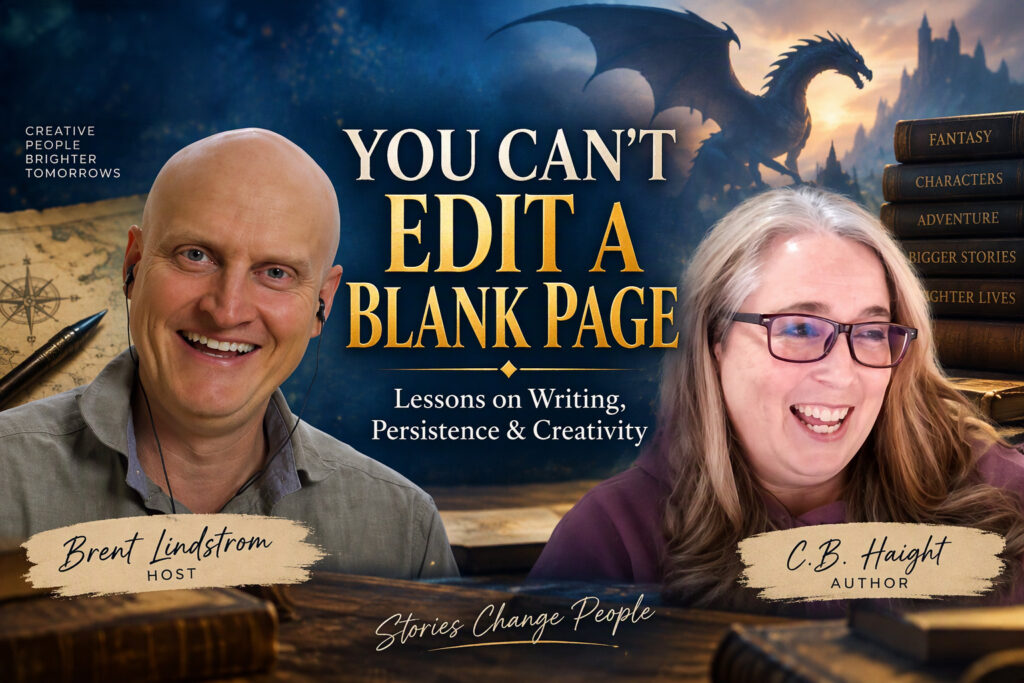
I recently sat down with fantasy author C.B. Haight on the Light-Minded Arts podcast, expecting to have a conversation about writing fantasy novels. We certainly talked about that. We also talked about dragons, Dungeons & Dragons, Brandon Sanderson, Korean dramas, family-friendly storytelling, publishing, readers, and the state of modern media.
One of the things I enjoyed most about talking with Camille was that she doesn’t treat creativity as some mysterious gift that descends from the heavens. She talked openly about drawing inspiration from her large family, from games she played with her children, from stories she encountered in unexpected places, and from the people around her every day. Listening to her reminded me of something I’ve observed over the years: artists are rarely short on inspiration. More often we’re short on attention. We walk past dozens of story ideas every day because we’re convinced inspiration needs to look dramatic before it’s worth noticing.
C.B. Haight’s Writing Career
Her writing career itself began in a surprisingly ordinary way. She was creating stories for Dungeons & Dragons campaigns, and her husband kept encouraging her to write them down. From those gaming sessions eventually came published novels. That’s one of those stories I love because it strips away the myth that successful creative projects begin with some grand master plan. More often they begin with someone saying, “You know, that’s actually pretty good. You should keep working on it.”
That led us into a discussion about community, and honestly, it challenged some assumptions I used to have.
When I first started writing, I believed artistic growth was largely a solo endeavor. I thought if I worked hard enough, read enough books, and put in enough hours, I could essentially teach myself everything I needed to know. While there is some truth to that, I’ve become increasingly convinced that artists grow faster when they spend time around other artists.
Camille spoke several times about the people who have helped her along the way. Family members inspired characters. Her husband encouraged her writing. Her daughter and son-in-law contributed artwork and maps. Friends provided support and feedback. Readers offered encouragement. As she described all these different relationships, it occurred to me that almost nobody succeeds alone. We may write alone. We may draw alone. We may sit in editing rooms alone. But our growth almost always happens in relationship with other people.
I’ve found this especially true in both writing and filmmaking. The more I interact with other creators, the more I realize that artists are usually far less competitive than outsiders assume. In many industries, success is a zero-sum game. Somebody else’s win feels like your loss. In the arts, I’ve often found the opposite. Most artists are genuinely excited when another artist succeeds because they understand how difficult the journey actually is.
Early Work.
Both Camille and I laughed about looking back at projects from earlier in our careers. At the time you’re creating something, it feels brilliant. A few years later you look at the same work and see every flaw. It’s easy to feel embarrassed by those older projects.
The older I get, though, the less embarrassed I am by my early work.
In fact, I’ve come to see those imperfections as evidence of progress. The reason old work looks rough is because we’ve grown. If we waited until we were good enough before creating anything, we’d never create at all. Every book, every script, every painting, every film becomes part of the education. The mistakes aren’t separate from the process. They are the process.
We also spent some time talking about success, and I appreciated Camille’s perspective on it. Like many artists, she started her creative journey wondering if she had begun too late. That’s a fear I’ve heard from countless writers, filmmakers, musicians, and entrepreneurs. There’s always someone younger, someone more accomplished, someone who appears to be further ahead.
But success has a funny way of changing shape as you get older.
When we’re young, success often looks like fame, money, awards, and recognition. As time passes, success starts looking more like consistency. Did you finish the project? Did you improve? Did you learn something? Did you create something meaningful that didn’t exist before? Those questions become far more important than whether a particular project became a bestseller.
Perhaps my favorite moment of the entire interview came near the end when I asked her what advice she would give to artists who are struggling.
Her answer: Don’t stop.
She talked about writing even when the writing feels bad. She talked about creating even when you’re unsure of yourself. She talked about continuing even when confidence is nowhere to be found. Then she said something every writer understands instantly:
“You can’t edit a blank page.”
The more I think about it, the more I realize that advice extends beyond writing. You can’t improve a film that was never shot. You can’t revise a painting that was never painted. You can’t strengthen a business that was never started. You can’t make draft number two until draft number one exists.
Artists spend so much time worrying about quality that they sometimes forget the first requirement for quality is completion.
Maybe that’s what I took away most from my conversation with C.B. Haight. Not a lesson about fantasy writing or publishing or marketing books, but a reminder that creative work is ultimately an act of perseverance. The people who eventually produce meaningful bodies of work aren’t necessarily the most talented. They’re often the people who simply kept showing up long after the excitement wore off.
And eventually, all those imperfect pages became something worth sharing.
You can find C.B. Haight at:
Leave a Reply