
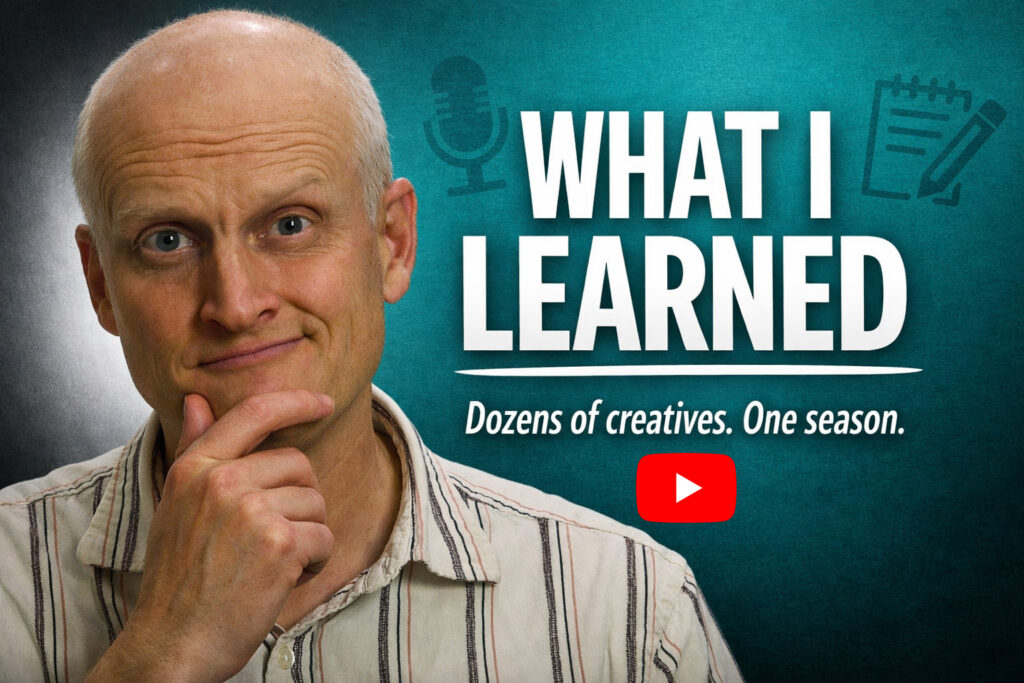
Last year was a crash course in creativity. I talked with writers, filmmakers, financial coaches, and life coaches — people chasing clarity, craft, and meaning in their work.
The biggest lessons weren’t just about art. They were about how to live as an artist without losing your sanity, your family, or your financial footing.
This is Part 1 of my season recap, where I talk about some of the things that stood out most to me. Not that this is all there was, but hey, for my journey, this is what I got out of it. Maybe you found something different.
1. Don’t Fall for the “Struggling Artist” Trap
Almost everyone I spoke with said the same thing: don’t quit your day job too soon.
When you’re starting out, your world is small. Every job, every person you meet, every weird argument you have becomes raw material for your art. John DeDacus reminded me that every job is grist for your fiction, and he’s right. My years in construction, real estate, and even telemarketing shaped how I write and how I see people.
And yes, your day job pays the bills. Art rarely does at first. I learned that the hard way when I tried to turn writing into a side income while raising a family. I had passion but no craft. It took years of rewriting, studying story structure, and building discipline before my words started to work.
2. Discipline Beats Inspiration
I’m terrible at working from home. Every interruption shattered my focus. So I started waking up at 5:30 a.m. to write before my family stirred. That single change transformed everything — I could focus fully on my creative work, then give my family my full attention later.
I treated writing like a job: one to two hours every morning, sometimes during lunch breaks, and study sessions at night. That rhythm built consistency, and consistency built skill.
3. Learn to Think Like an Entrepreneur
Art is a business. Daniel Rogers reminded me that hard work doesn’t guarantee sales. R.L. Carpenter said it plainly: you need business sense.
If you want your art to be sustainable, you have to understand:
- Who your audience is
- What they want
- How to manage money, contracts, and marketing
- How to value your time and creative output
When I calculated the true cost of publishing a book — editing, cover design, formatting, marketing, and time — it came out to roughly $35,000. That number shocked me, but it’s real. Your time is worth something. If you don’t value it, no one else will.
4. Diversify and Systematize Your Income
Jeff and Rory — two guests who live this principle — taught me that creative success often depends on multiple revenue streams.
Your art might not pay the bills right away, but your skills can. Writers can teach workshops, filmmakers can sell tutorials, podcasters can monetize their insights. Find ways to repackage what you know and turn it into adjacent income.
And remember: “passive income” isn’t truly passive. Every stream requires maintenance. But those streams can buy back your time, letting you outsource tasks and focus on what moves your creative work forward.
5. Build Freedom, Not Escape
After years of balancing business, writing, and family, I finally stepped away from my company and handed it to my brother. Now, I’m diving back into filmmaking and creative storytelling full-time, not because I escaped the day job, but because I used it to build freedom for the day job I wanted.
If you’ve followed the podcast this season, thank you. If you’ve found value in these lessons, the best way to support the work is simple: pick up one of my books and leave a review. That’s how this creative journey keeps going.
Key Takeaways
- Keep your day job until your art can sustain you.
- Build discipline through routine, not mood.
- Treat your art like a business.
- Diversify your income streams.
Leave a Reply