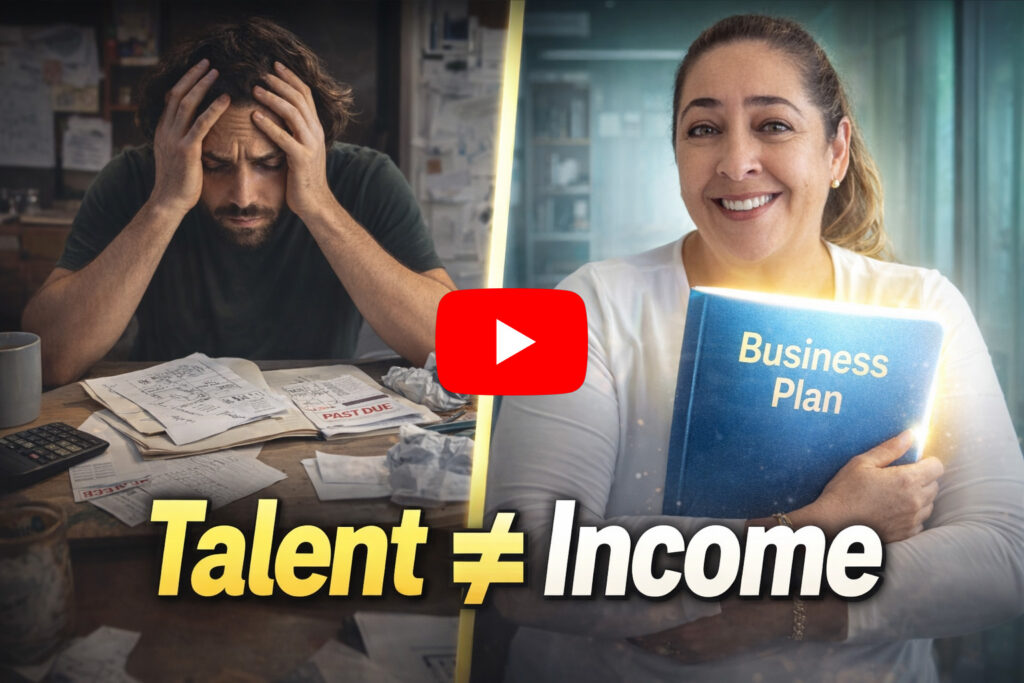
If you’ve ever tried to turn your art into income, you’ve probably had this moment:
You’re staring at your bank account, wondering how you can be this talented and still this broke… while some 19-year-old on TikTok is selling crocheted frog hats and somehow clearing six figures.
Welcome to the creative economy — where talent matters, but financial literacy matters more.
And that’s exactly why my conversation with Sheila Slick hit so hard. Sheila is a fourth-generation entrepreneur, a business coach, a tech founder, and the author of Momentum. She grew up in a family where dinner conversations were basically Shark Tank without the cameras. Meanwhile, most creatives grew up hearing things like:
“Just follow your passion and the money will come.”
Spoiler: it won’t.
Not unless you treat your creativity like a business — and Sheila breaks down exactly how.
1. Ideas Are Cheap. Execution Is Expensive.
Creatives love ideas. We collect them like Pokémon.
But Sheila said something worth remembering:
“An idea is just the beginning. The question is, how do you go from idea to action?”
Writers know this intuitively. “I have an idea for a book” is not a book. It’s not even a chapter. It’s a sentence fragment.
But when it comes to business? Creatives forget this rule entirely.
We think:
- “I’ll publish this book and see what happens.”
- “I’ll post my art online and hope it sells.”
- “I’ll make a film and pray someone discovers it.”
Hope is not a business plan.
Sheila’s entire career — from NASA hackathons to building a micro-SaaS — is proof that ideas don’t pay the bills. Systems do.
2. You Need a Business Plan (Yes, Even You, Painter-Who-Hates-Spreadsheets)
Sheila spent years helping entrepreneurs through SCORE, where she taught the nine essential elements of a business plan. And she’s blunt about it:
Most creatives skip this step entirely.
Why? Because it feels boring. Restrictive. “Uncreative.”
But here’s the truth:
A business plan doesn’t kill creativity — it protects it.
It keeps you from:
- Underpricing your work
- Overspending on tools
- Getting blindsided by costs
- Burning out
- Quitting your dream because you “can’t afford it”
Sheila put it perfectly when she said:
“At one point, unless it’s a hobby, you have to figure out how not to lose money.”
That’s the line creatives avoid. We don’t want to admit we’re running a business. But if you want to be a working creative, not a struggling one, you need to know:
- What your work costs
- What your time is worth
- Who your audience is
- How you’ll reach them
- How you’ll price sustainably
This isn’t selling out.
This is staying in the game.
3. Validate Your Market Before You Build Anything
Sheila’s story about building Pod2Book AI is a masterclass in creative entrepreneurship.
She didn’t spend a year building a perfect product.
She didn’t disappear into a cave to “work on her craft.”
She didn’t assume people wanted what she wanted to make.
Instead, she validated the idea while building it.
She watched what podcasters were already doing manually. She saw the pain point. She built a rough version. She gave it to testers. She asked for feedback. She iterated. She improved. She partnered with people who already had audiences.
And she said something every creative needs to hear:
“If it’s going to fail, you want it to fail fast.”
Creatives do the opposite.
We fail slowly. Painfully. Expensively.
We spend:
- 3 years writing a novel
- $20,000 making an indie film
- 6 months painting a collection
…before ever asking:
Does anyone want this?
Market validation isn’t selling out.
It’s making sure you’re not building a business on quicksand.
4. Collaboration Is Not Optional — It’s Survival
One of Sheila’s first moves with her app was to collaborate.
Not “network.”
Not “ask for favors.”
Not “hope someone shares it.”
She created revenue-sharing partnerships with people who already had audiences.
That’s how you scale without burning out.
Creatives often try to do everything alone:
- Write the book
- Edit the book
- Design the cover
- Market the book
- Build the website
- Run the ads
- Manage the social media
And then we wonder why we’re exhausted and broke.
Sheila’s approach is simple:
Find people who are already serving your audience and make it worth their while to help you.
This is how real businesses grow.
5. Momentum Is a Financial Strategy
Sheila’s book Momentum isn’t just about productivity — it’s about financial survival.
Because the #1 killer of creative careers isn’t lack of talent.
It’s inconsistency.
She said:
“Momentum is where I see a lot of people get stuck.”
Creatives sprint, then collapse.
We binge-work, then ghost our own projects.
We get excited, then overwhelmed.
Momentum isn’t about working harder.
It’s about working sustainably.
Sheila uses:
- Time blocks
- Boundaries
- Project prioritization
- Saying “no” to good opportunities to protect great ones
She even turned down lucrative software clients because they didn’t align with her current focus.
That’s discipline.
That’s strategy.
That’s how you build wealth instead of chaos.
6. Fear Is Expensive
Sheila talked about participating in a NASA hackathon — despite knowing nothing about space.
She almost didn’t do it.
She was intimidated.
She doubted herself.
And then her team’s project was chosen as one of the best worldwide.
Her takeaway?
“Fear stops us. Limiting beliefs stop us.”
Fear is one of the most expensive emotions a creative can have.
Fear keeps you from:
- Charging what you’re worth
- Pitching your work
- Publishing your book
- Launching your product
- Asking for help
- Showing up consistently
Fear costs more than failure ever will.
7. The Hardest Part of Creative Entrepreneurship Isn’t Money — It’s Consistency
When I asked Sheila what the hardest part is, she didn’t hesitate:
“Consistency. Staying sane. Staying focused. Taking it to the finish line.”
Creatives love the beginning of things.
We love the spark.
The inspiration.
The rush.
But businesses are built in the boring middle.
The unsexy grind.
The follow-through.
The repetition.
Momentum isn’t glamorous.
But it’s profitable.
Final Thought: Your Art Deserves a Financial Strategy
Sheila’s entire journey — from tourism to tech to publishing — is proof that creativity and business are not opposites.
They are partners.
Your creativity is the engine.
Your business strategy is the steering wheel.
Without both, you crash.
If you want to stop being a struggling artist and start being a working creative, take Sheila’s advice seriously:
- Validate your ideas
- Build a simple business plan
- Know your numbers
- Collaborate strategically
- Protect your time
- Stay consistent
- Don’t let fear run the show
Your art deserves to be seen.
But more importantly — you deserve to be paid.
To learn more about Sheila Slick, visit her website at: https://sheilaslick.com/
Leave a Reply