
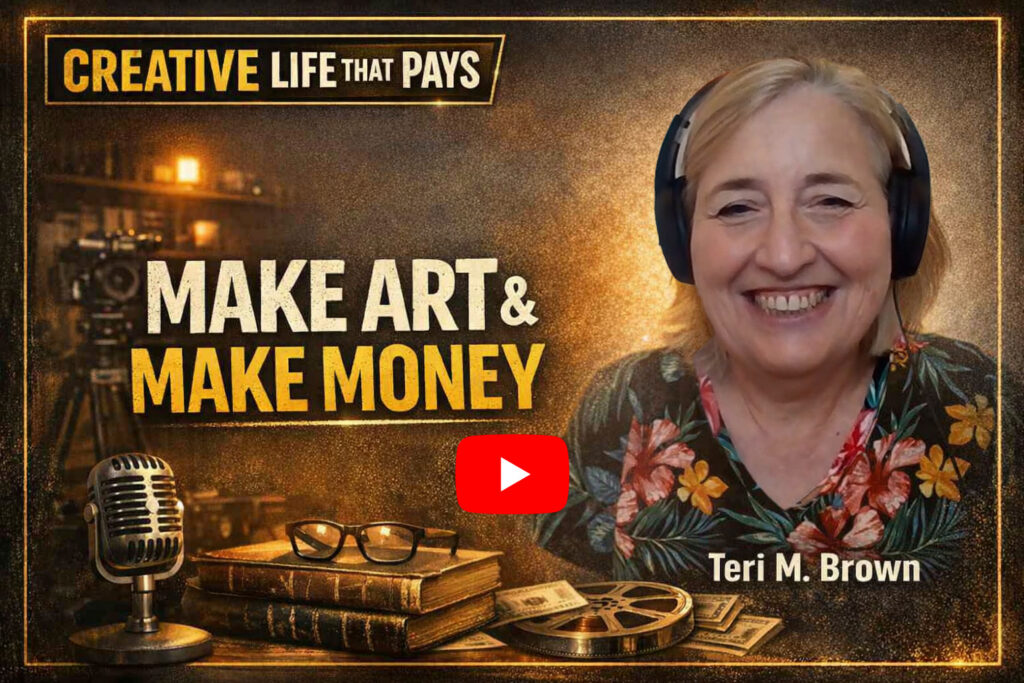
There are interviews that feel like interviews… and then there are interviews that feel like someone just handed you a flashlight and said, “Hey, you’ve been stumbling around in the dark—want to see where the walls actually are?”
My conversation with award-winning author Teri M. Brown was the second kind. And yes, I do plan on revisiting my conversation with her myself over the coming months to help me in my own efforts as an author! So Pay attention.
I brought her on Light-Minded Arts because she’s one of those rare creatives who has figured out both sides of the creative life: the soul-driven, character-obsessed writer and the business-savvy professional who actually sells books. Lots of them. Sustainably. Without losing her mind.
And honestly? I wanted to learn from her. I wanted other writers to learn from her. Because the struggling artist trap isn’t just about money—it’s about mindset, systems, and the courage to keep going even when your first attempts are “no good” (her words, not mine).
This blog is a breakdown of the biggest lessons she dropped—lessons that can help any creative stop flailing and start building something real.
1. Reinvention Isn’t a Luxury—It’s a Survival Skill
One of the first things Teri shared was her backstory. Everyone I’ve talked to has one, but hers gave her that motivation to keep going. I share this with you, only because it sets the frame for the marketing drive she created later.
She didn’t start writing novels until after escaping a 14-year emotionally abusive marriage. She’d been writing for small businesses, mostly practical, research-based nonfiction, but she’d never had the safety or confidence to write fiction.
Then she left.
And the words poured out.
Not perfect words. Not publishable words. But her words.
“My first manuscript was no good. My second manuscript was no good. But I wrote them.”
Because the struggling artist trap often begins with the belief that your early work must be brilliant. Teri’s early work wasn’t brilliant. It was practice. It was healing. It was the foundation for everything she’s built since.
Takeaway for creatives: Your first attempts aren’t supposed to be good. They’re supposed to get you to the next attempt.
2. Big, Bold Actions Change Your Identity
Teri and her new husband Bruce rode a tandem bicycle across the United States—from Oregon to Washington, D.C.
Let me repeat that: A woman who hadn’t been on a bike in 40 years rode across the entire country. And that experience rewired her brain.
“If I can do that, I can do anything I put my mind to.”
This wasn’t about fitness. It was about identity. She stopped seeing herself as someone who wanted to be an author and started seeing herself as someone capable of doing hard things.
Fourteen months later, her first novel was published.
Takeaway for creatives: Sometimes you need a big, unreasonable challenge to break the mental ceiling you’ve been living under. It doesn’t have to be a cross-country bike ride, but it has to be something that forces you to see yourself differently.
3. Writing the Book Is the Easy Part. Selling It Is the Job.
This is where I really got interested, because, I’m doing the writing, I’m publishing my books, but selling them is the hardest part.
When her first novel came out, she did what most new authors do:
She published it, and waited.
Nothing happened.
This is where many of us have been, and often still are. But Teri didn’t quit. She learned and built a system.
4. The Newsletter Is Your Lifeline (Not Optional)
Teri’s newsletter has 1,400 subscribers and a 70% open rate—numbers most authors would sacrifice a kidney for.
But she didn’t get there by accident.
She built it one person at a time:
- Every event she does includes a sign-up sheet.
- Every craft fair.
- Every library talk.
- Every coffee shop appearance.
- Every podcast interview.
Did you catch that? Look at that list again. Are you doing these things? They might not sell a lot, and you might never break minimum wage, but there is something increadibly important about doing all these in-person events!
Its that list she gains, one person at a time. One PERSONAL connection at a time. And she emails them twice a month—consistently, for years.
One newsletter is book reviews (including mine, which was a fun surprise).
The other is updates, behind-the-scenes stories, personal notes, and engagement prompts.
She treats her readers like a community, not a sales funnel.
Takeaway for creatives: Do the little events as often as you can to build an email list. Then talk directly to your audience. If you don’t have an audience. All you have is hope. Hope doesn’t sell books.
5. Reviews Don’t Fall from the Sky—You Have to Ask
Teri has 511 reviews on Daughters of Green Mountain Gap and 238 on Sunflowers Beneath the Snow at the time of our interview.
These numbers matter. Amazon’s algorithm rewards books with reviews. Readers trust books with reviews. Reviews are the social proof that keeps a book alive.
But people don’t leave reviews naturally.
“They read your book, they liked your book, they told you they liked your book… and that’s the end of the story.”
So she asks. Repeatedly. Kindly. Strategically.
She includes review links in her newsletter.
She explains that reviews can be short.
She asks people in person.
She asks them to do it right now on their phones.
And it works.
Takeaway for creatives: If you’re not actively asking for reviews, you’re leaving your book to die quietly in the algorithmic wilderness.
6. In-Person Events Still Matter (Maybe More Than Ever)
We’ve already covered this a little, but it needs to be reiterated. Teri does:
- Library talks
- Coffee shop events
- Craft fairs
- Local meet-the-author nights
- Anything that gets her in front of real humans
She doesn’t worry about turnout. If three people show up, that’s three new readers.
She also uses local Facebook groups to promote events—simple, free, effective. Often, all it takes, is calling up a place and asking. I’ve done this with book stores, and while those are good, you’re only getting passive visitors who need to be sold on you. Libraries and coffee shops often have email lists of their own that they use to advertise events. They do marketing for you, free, and so you already have an audience who came, just to see you talk.
Takeaway for creatives: Visibility isn’t just digital. If you want readers, go where readers physically are.
7. Paid Ads Can Work—But Only When the Foundation Is Solid
Teri didn’t touch paid ads until she already had:
- A strong newsletter
- A consistent presence
- Over 200 reviews
- A clear brand
- A book that converts well
Then she tried Facebook ads.
And they worked.
She tripled her investment. Her sales graph shot upward and stayed there. She sells about two books a day from that one campaign.
But she also shared a crucial insight:
“I’ve been told that if you don’t have at least 100 reviews, Facebook ads don’t work well.”
This tracks with what many marketers say: ads amplify what’s already working. They don’t fix what isn’t.
Takeaway for creatives: Ads are gasoline. They only help if your engine is already running.
8. Genre Isn’t a Prison—If Your Brand Is Clear
Often I’ve been worried that the common wisdom of “stick to one genre, or you’ll confuse your audience” was going to plague me, since I write what I want to write, and often in multiple genres, even blending them sometimes.
Teri wrote three historical fiction novels… and then wrote a modern, humorous contemporary novel. And her readers are excited for it.
Why?
Because she didn’t brand herself as a historical fiction author. She branded herself as a character-driven storyteller.
That’s the glue. That’s what readers follow. I’ve done something similar. Since I do write in multiple genres, I brand myself as a creator in the “clean fiction” space. My books aren’t squeaky clean, but they are for the most part PG or very mild PG-13, something most families are okay enjoying together.
Takeaway for creatives: Your genre can change. Your voice can’t. Build your brand around what makes your storytelling yours.
Final Thoughts: Teri’s Path Isn’t Magic—It’s Method
What struck me most about Teri is that nothing she does is mystical or unattainable.
She isn’t relying on luck or waiting for a viral moment. She isn’t hoping the universe notices her She’s building a career brick by brick:
- Write consistently
- Show up in person
- Build a newsletter
- Engage your readers
- Ask for reviews
- Learn the business
- Take bold risks
- Keep going
This is the opposite of the struggling artist trap. It’s the blueprint for escaping it.
And honestly? Talking to her made me rethink my own systems, my own habits, and the places where I’ve been relying on hope instead of structure.
If you’re a creative trying to build something sustainable, her example is a reminder that the path exists—and it’s walkable.
The only question is whether you’re willing to take the next step.
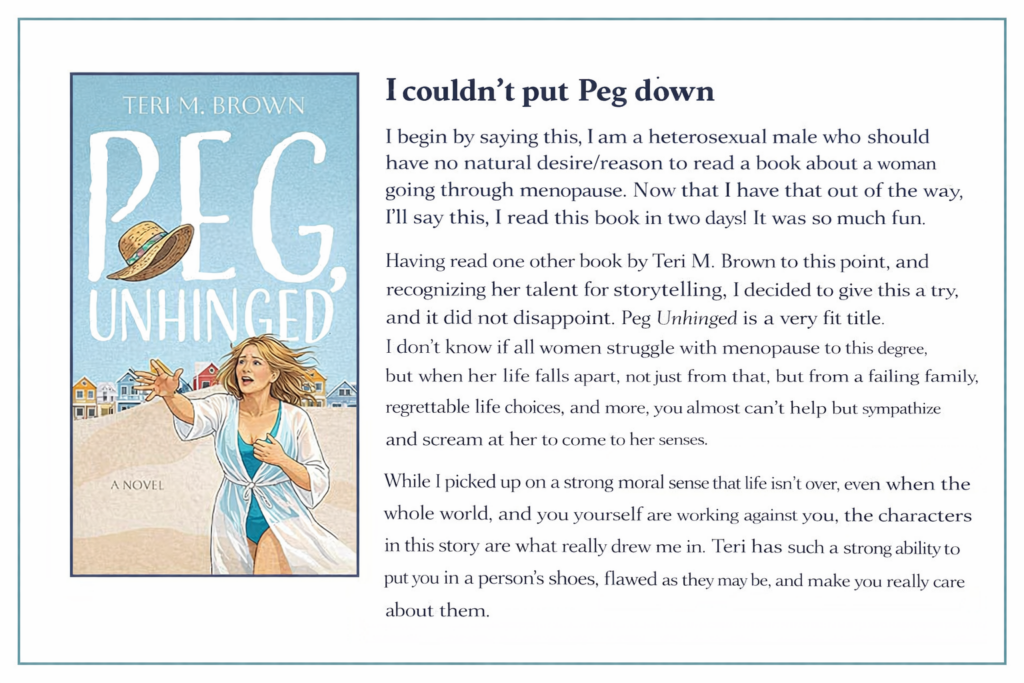
Check out Teri’s new book, Peg Unhinged today: https://www.amazon.com/Peg-Unhinged-Teri-M-Brown-ebook/dp/B0GTML786F/
Catch the whole podcast at: https://brentxp.podbean.com/e/no-one-is-coming-%e2%80%94-how-teri-m-brown-succeeded-in-marketing-her-creative-career/?token=3dc1a2ce83b5a72dd495c276b2555b60
Visit Teri M. Brown’s Website: https://www.terimbrown.com/
Leave a Reply