
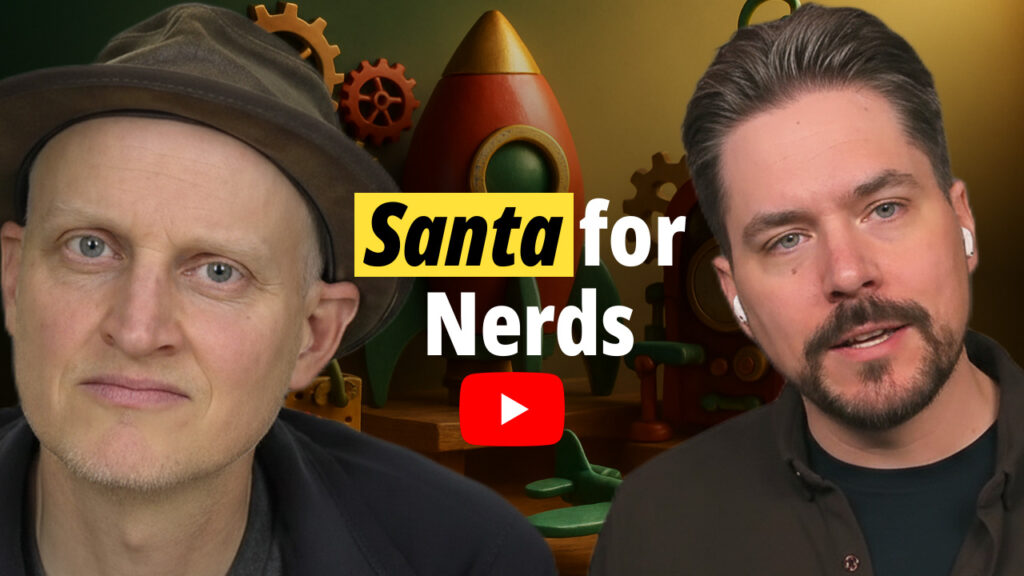
Every once in a while, I meet someone whose story doesn’t just inspire me — it re-calibrates something in my brain. Not because they’ve lived some glamorous Hollywood life or because they’ve “made it” in the traditional sense, but because they’ve carved out a life that looks suspiciously like freedom.
That was my conversation with artist, designer, fabricator, and creative coach Paul Pape — also known online as Santa for Nerds. And if you’ve never heard that name before, trust me, by the end of this, you’ll understand exactly why it fits.
Paul is one of those rare creatives who didn’t just survive the starving-artist narrative — he dismantled it, rebuilt it, and turned it into a thriving 20-year business making custom collectibles for everyone from everyday fans to Disney, Universal, Nickelodeon, and The Tonight Show.
But the part that stuck with me wasn’t the résumé. It was the philosophy behind it.
This is the story of a kid who wanted to be a wizard… and somehow became one.
The Kid Who Wanted to Be a Wizard
When I asked Paul who he was as a kid, he didn’t hesitate.
“I wanted to be a wizard,” he said.
Not an astronaut. Not a firefighter. A wizard.
He was the kid who hid in the library during recess, the kid who devoured fantasy novels, the kid who convinced himself for a full year that he was an elf adopted by humans. And honestly… I get it. Some of us didn’t grow out of imagination — we grew into it.
But imagination alone doesn’t build a career. And like a lot of creatives, Paul hit that moment where the world tried to shrink him down.
For him, it happened in college.
He declared a theater major on day one, ready to become an actor. A year later, the head of acting told him he’d never be cast again because he couldn’t memorize lines.
Most people would’ve quit.
Paul pivoted.
That’s the first theme of his life — and the one I think every creative needs tattooed on their brain:
Bend, don’t break.
The Scenic Designer Who Accidentally Became an Entrepreneur
After being told he’d never act again, Paul threw himself into the backstage world — scenic design, costume design, props. And he was good. Award-winning good. Broadway-adjacent good.
But then he had a conversation that changed everything.
He asked a Broadway designer what it was like being at the top.
The guy told him the truth:
“It sucks.”
Forty-eight weeks a year on the road. Paying rent on an apartment he never saw. Assistants doing all the paperwork. Constant hustle. No stability. No life.
That’s when Paul realized something important:
Success that costs your life isn’t success.
So he bent again.
He didn’t quit creativity — he just stopped forcing it into the shape the industry told him it had to be.
And that’s when the magic started.
The $500,000 Idea That Started with a Greeting Card
While designing a show full of miniature chairs, Paul found himself hand-cutting tiny cardstock furniture for a scale model. Ninety chairs in, he hit the wall every creative knows:
“There has GOT to be a better way.”
Then he saw a greeting card with laser-cut lace.
That moment — that tiny spark of curiosity — turned into his first product: Pop Out Furniture, laser-cut miniature furniture for designers, architects, and dollhouse makers.
It made half a million dollars.
He went from a $19,000-a-year grad student to IRS-audit levels of income overnight.
But here’s the part I love:
When home laser cutters and 3D printers hit the market, Paul didn’t cling to the old model. He didn’t fight the tide.
He bent again.
He let the business go and followed the next thread.
The Sculptor Who Went Viral Before “Going Viral” Was a Thing

Back in Nebraska, teaching at his old university, one of Paul’s students asked him to sculpt a Nintendo Wii avatar as a Valentine’s gift.
He made it. The student posted it on a site called Super Punch. And it blew up.
Suddenly Paul was making thousands of these little avatars by hand. Then Xbox avatars. Then World of Warcraft characters. Then wedding cake toppers. Then custom engagement ring boxes shaped like golden snitches.
Every request was different. Every project was new. Every piece was custom.
And every business expert told him the same thing:
“You can’t build a business on custom work.”
Twenty years later, he’s still proving them wrong.
The Twitch Stream That Turned Into a Calling
After years of working alone in his basement studio, Paul missed people. So he Googled “perform art on camera live” and stumbled onto Twitch.
He started streaming his creative process five days a week. People watched. People asked questions. People wanted to know how he built a creative business that actually worked.
And Paul noticed something:
People don’t value free advice.
They value transformation.
So he shifted again — from maker to mentor.
That’s where his TEDx talk came from. That’s where his coaching practice came from. And that’s where one of my favorite ideas from our conversation came from:
**Creatives don’t make products.
Creatives make magic items.**
The Gamified Mindset Every Creative Needs
Paul teaches creatives to think of their work like items in a role-playing game.
Not mass-produced junk.
Not “just another painting” or “just another book.”
But magic items with rarity levels.
- A common item is something anyone can make.
- An uncommon item takes skill.
- A rare item takes mastery.
- A legendary item?
That’s something only you can create.
And legendary items aren’t cheap.
They’re not supposed to be.
In games, you grind for them. You save for them. You sacrifice for them. Because they change the way you play.
That’s how creatives need to see their work — not as commodities, but as artifacts infused with their soul, their story, their skill, and their irreplaceable perspective.
So What’s the Biggest Mistake Creatives Make?
I asked Paul this directly.
He didn’t hesitate.
“They don’t understand their worth.”
And right behind that:
“They don’t understand the seed of what they’re trying to put out into the world.”
Most creatives think they’re selling a thing.
They’re not.
They’re selling transformation.
Identity.
Emotion.
Memory.
Magic.
When you understand that, everything changes — your pricing, your confidence, your marketing, your posture, your entire creative life.
Final Thoughts: Mowing Your Own Path
Paul’s wife once told him, “You mow your own path.”
I love that.
Some people follow the trail.
Some people get lost in the weeds.
And some people — the ones who bend instead of break — carve out a path no one has ever walked before.
That’s what Paul did.
That’s what he teaches others to do.
And honestly, that’s what every creative needs to learn if they want to stop struggling and start thriving.
Because the world doesn’t need more starving artists.
It needs more wizards.
Learn more about how Paul can help you on your creative journey at: https://www.gamifybusiness.com/
Also, you can listen to the whole interview on my podcast.
Leave a Reply